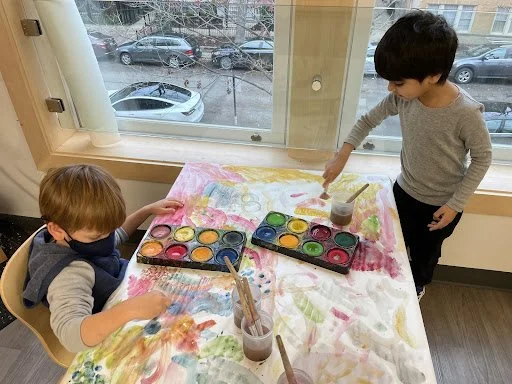
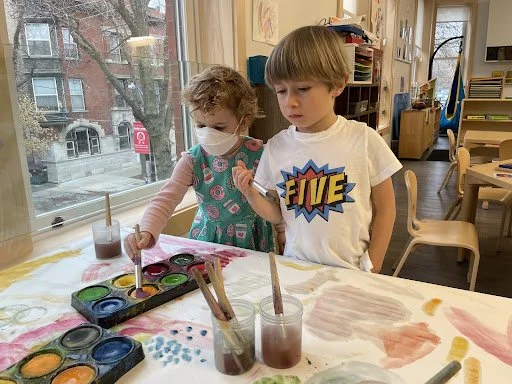
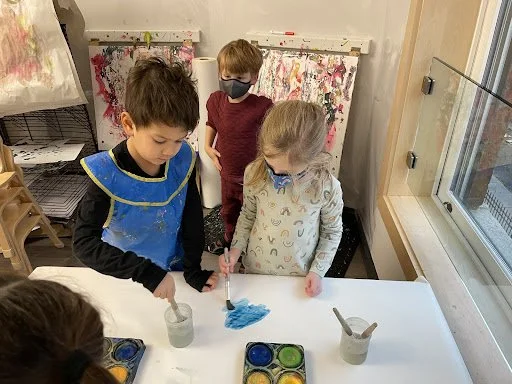
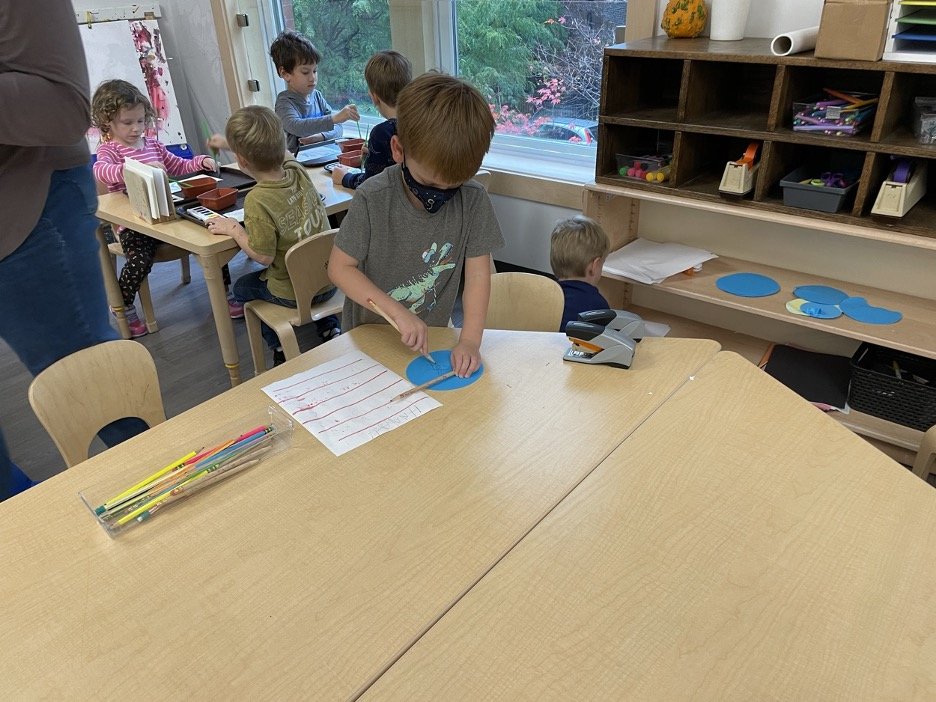
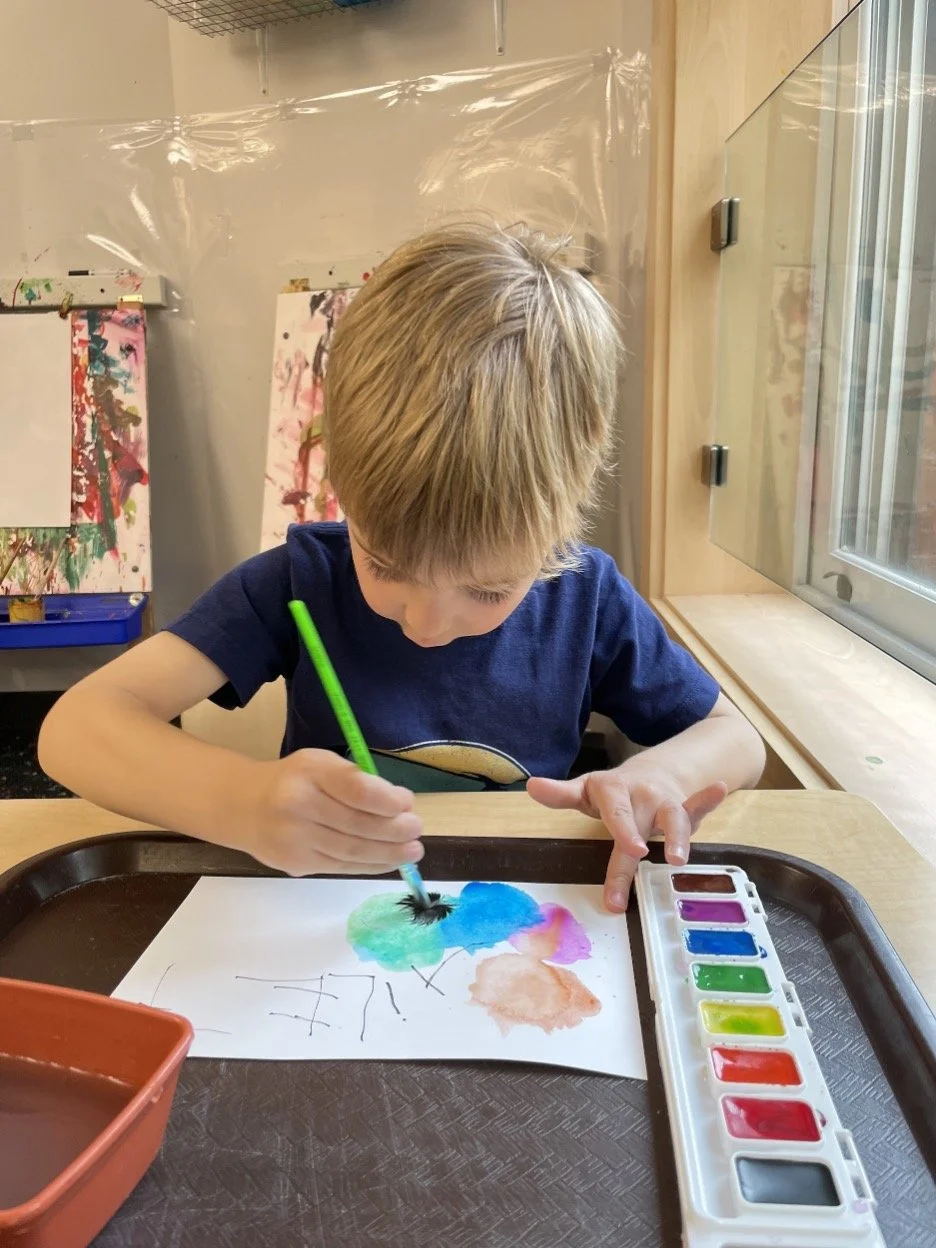
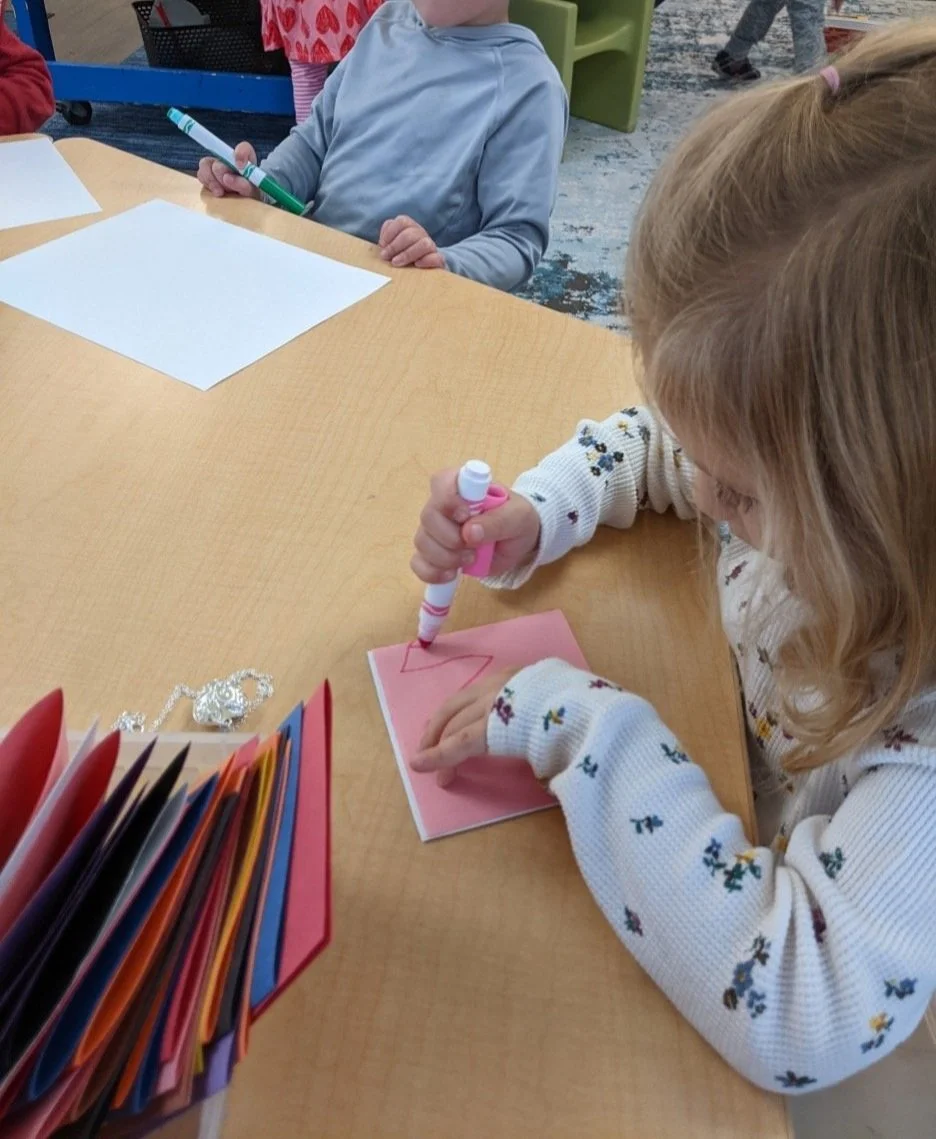
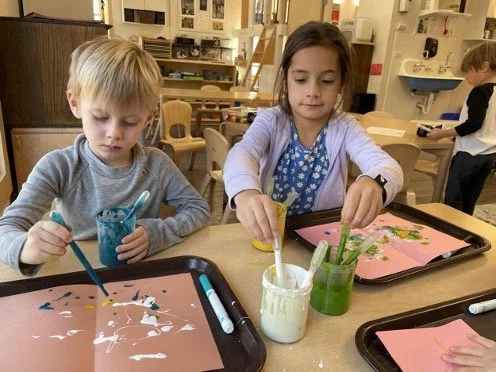
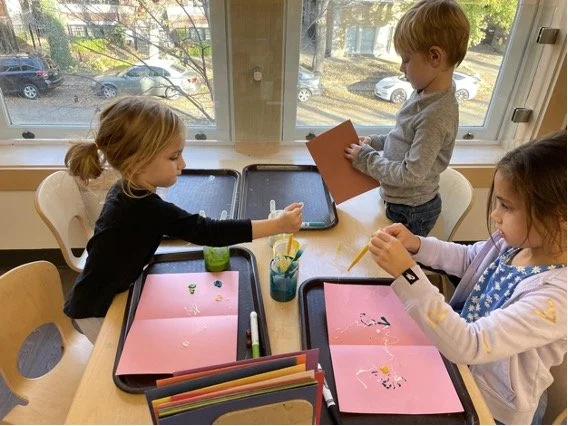
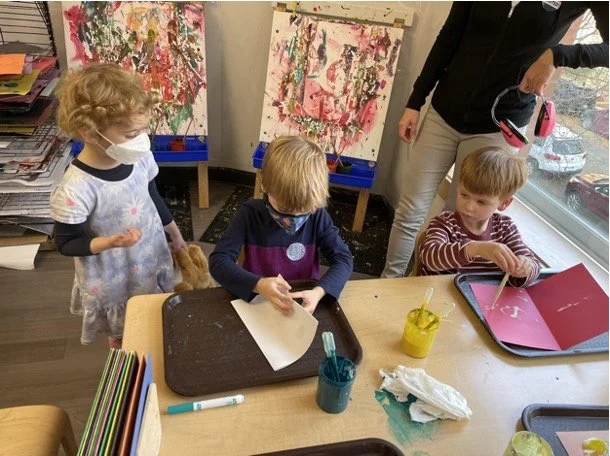
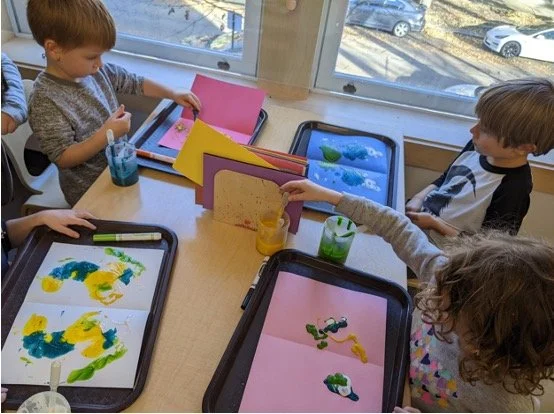
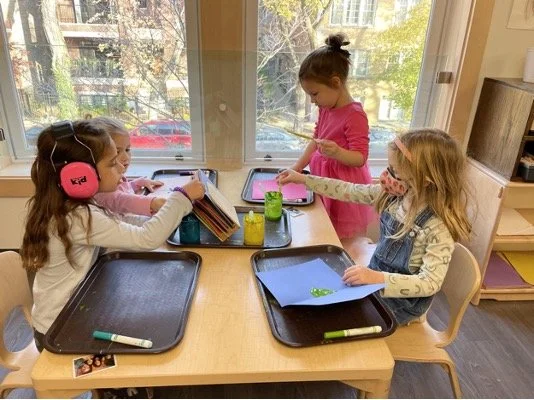
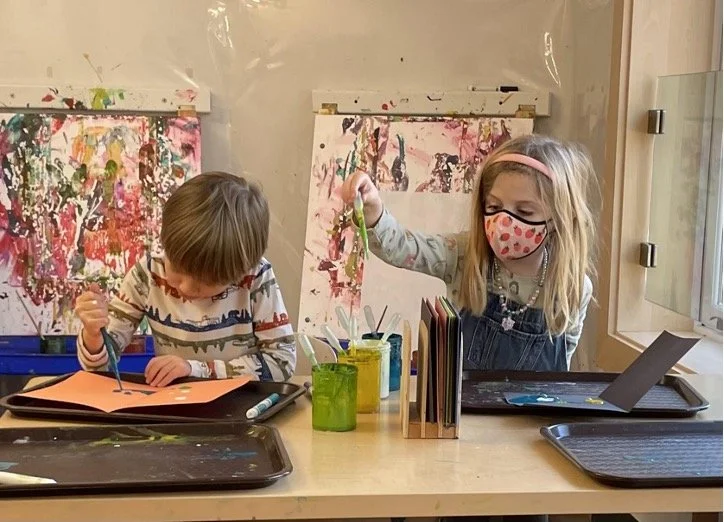
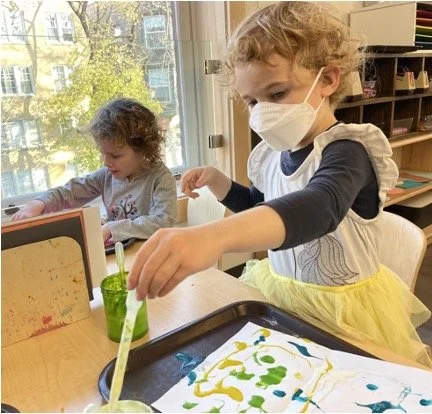
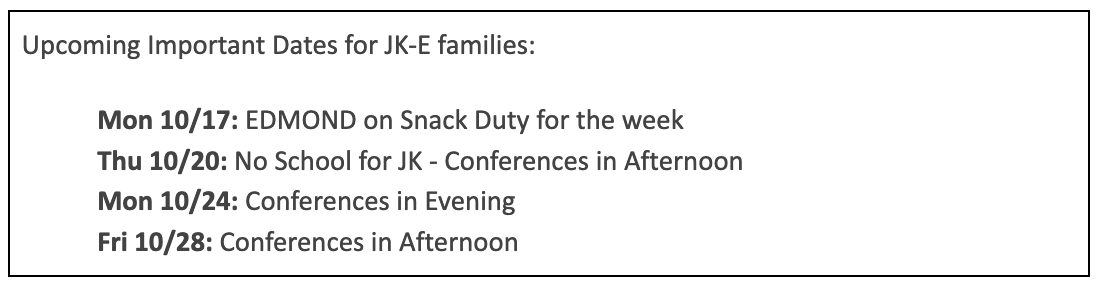
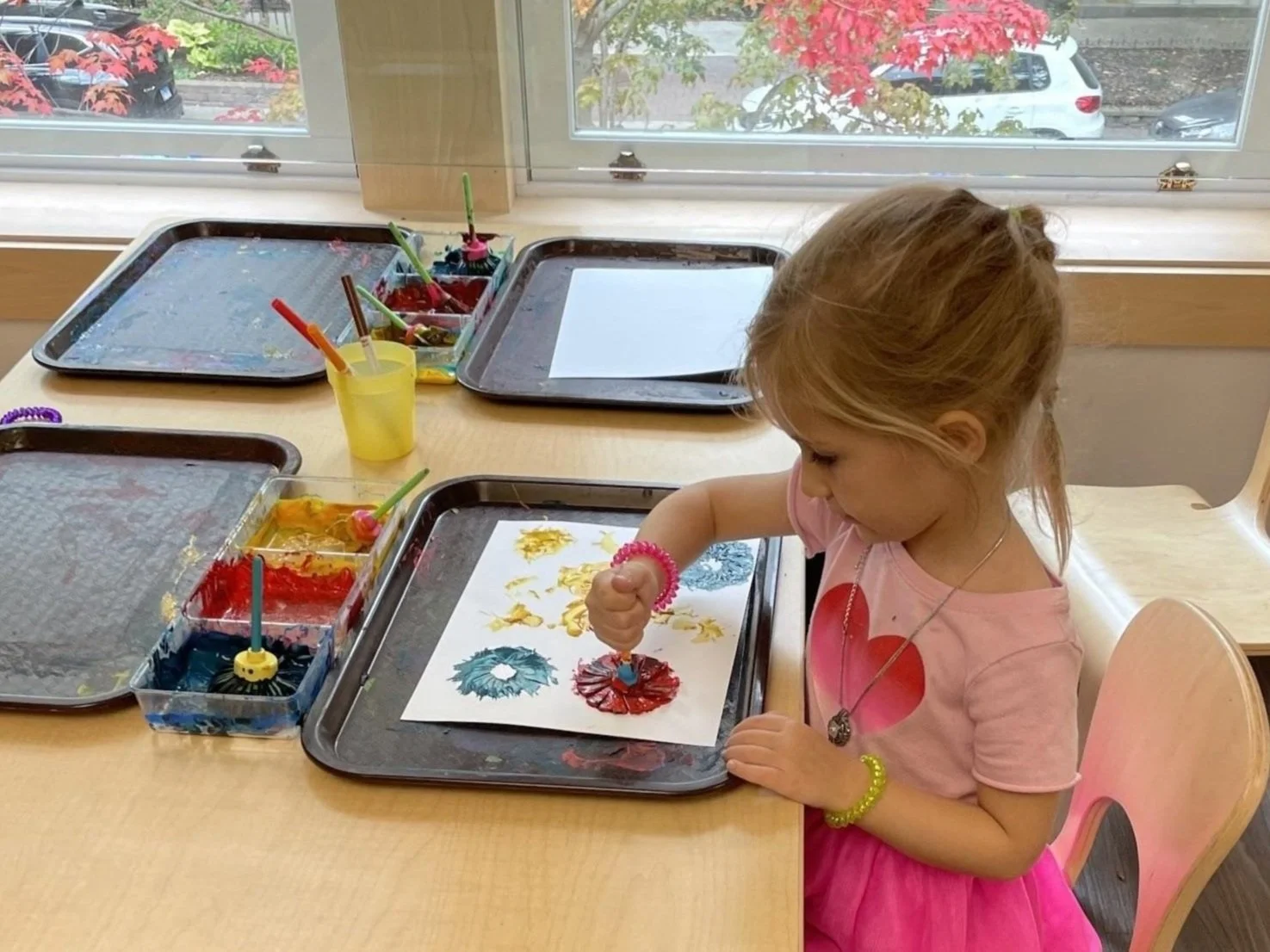
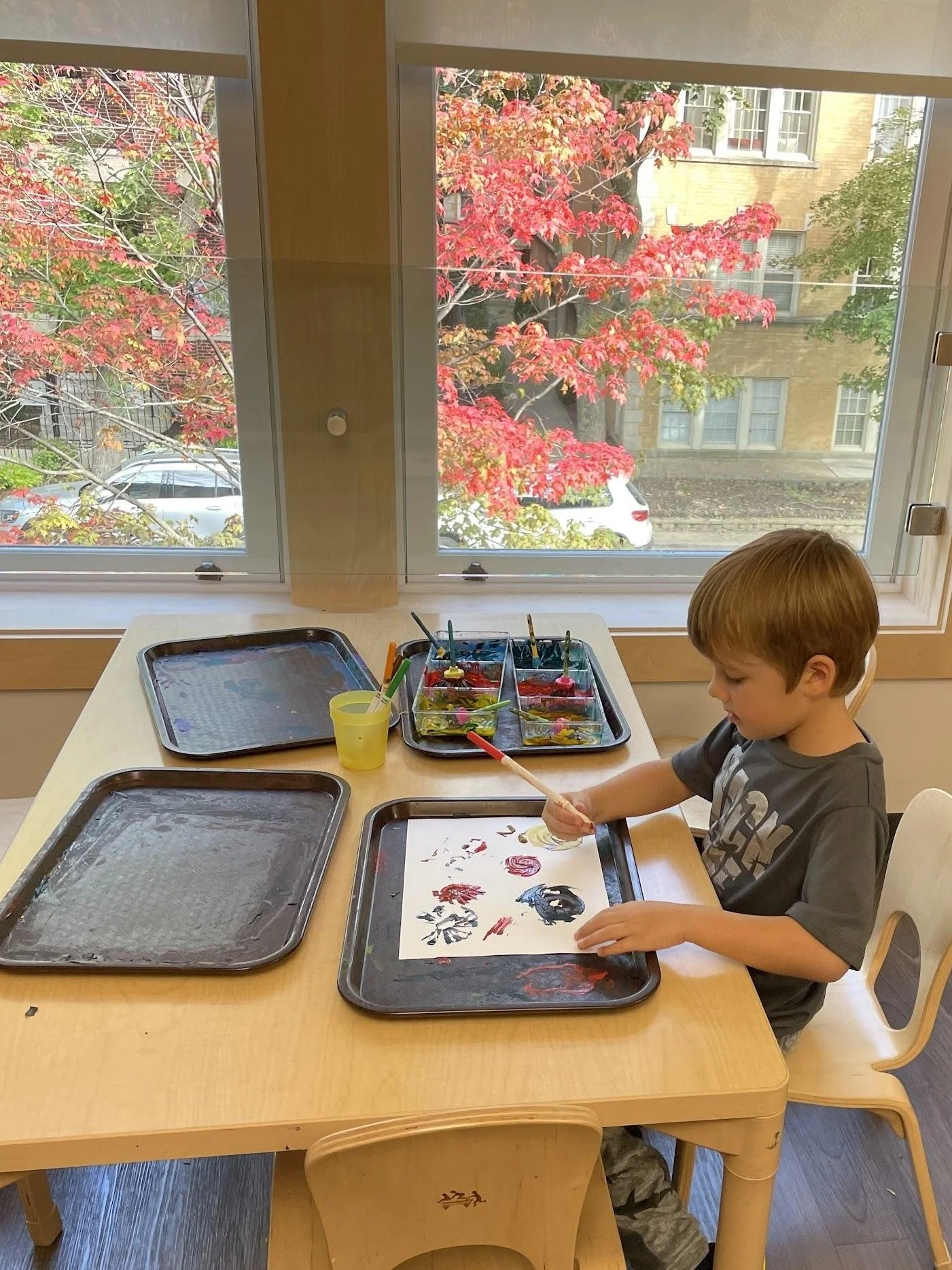
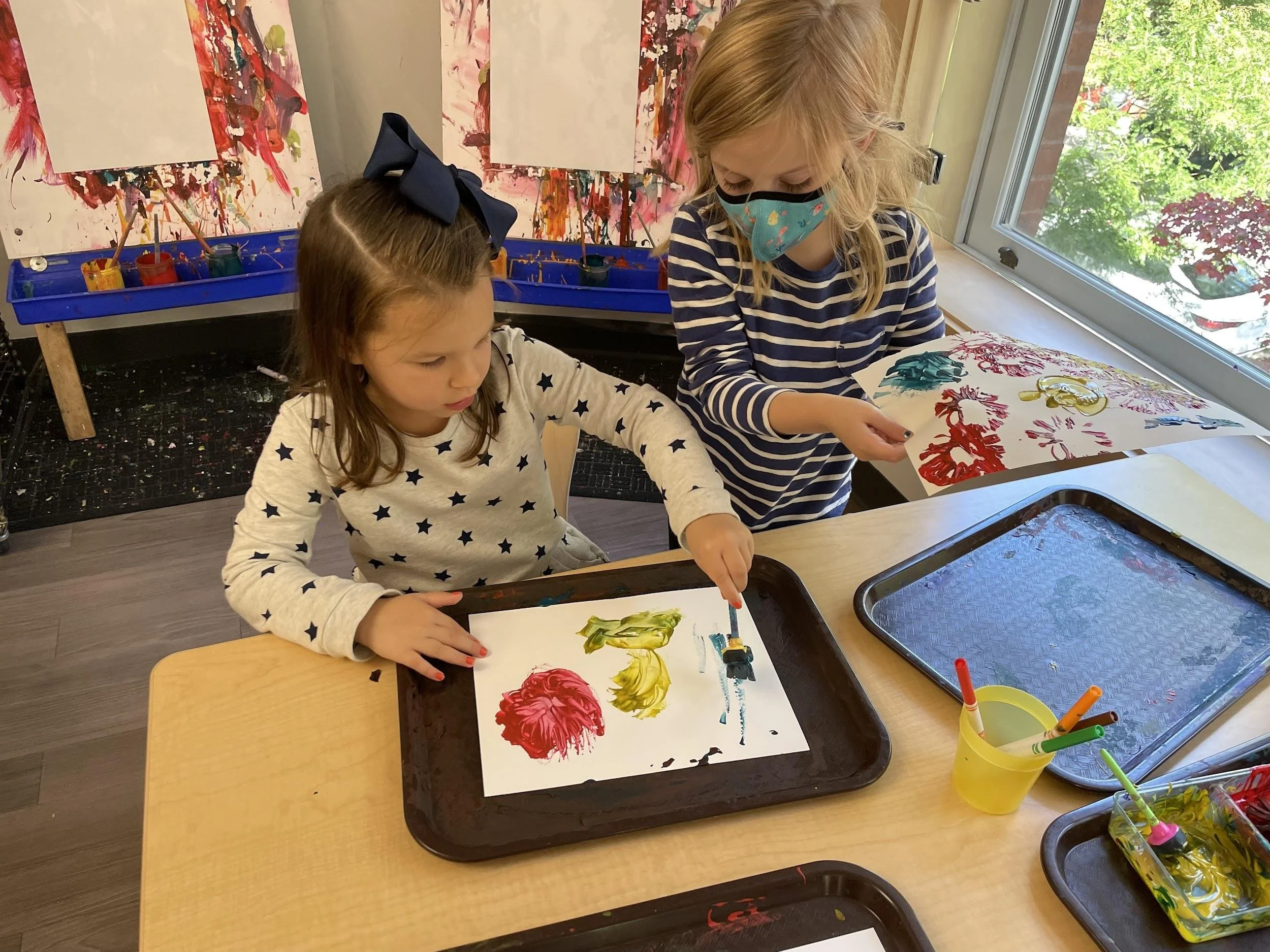
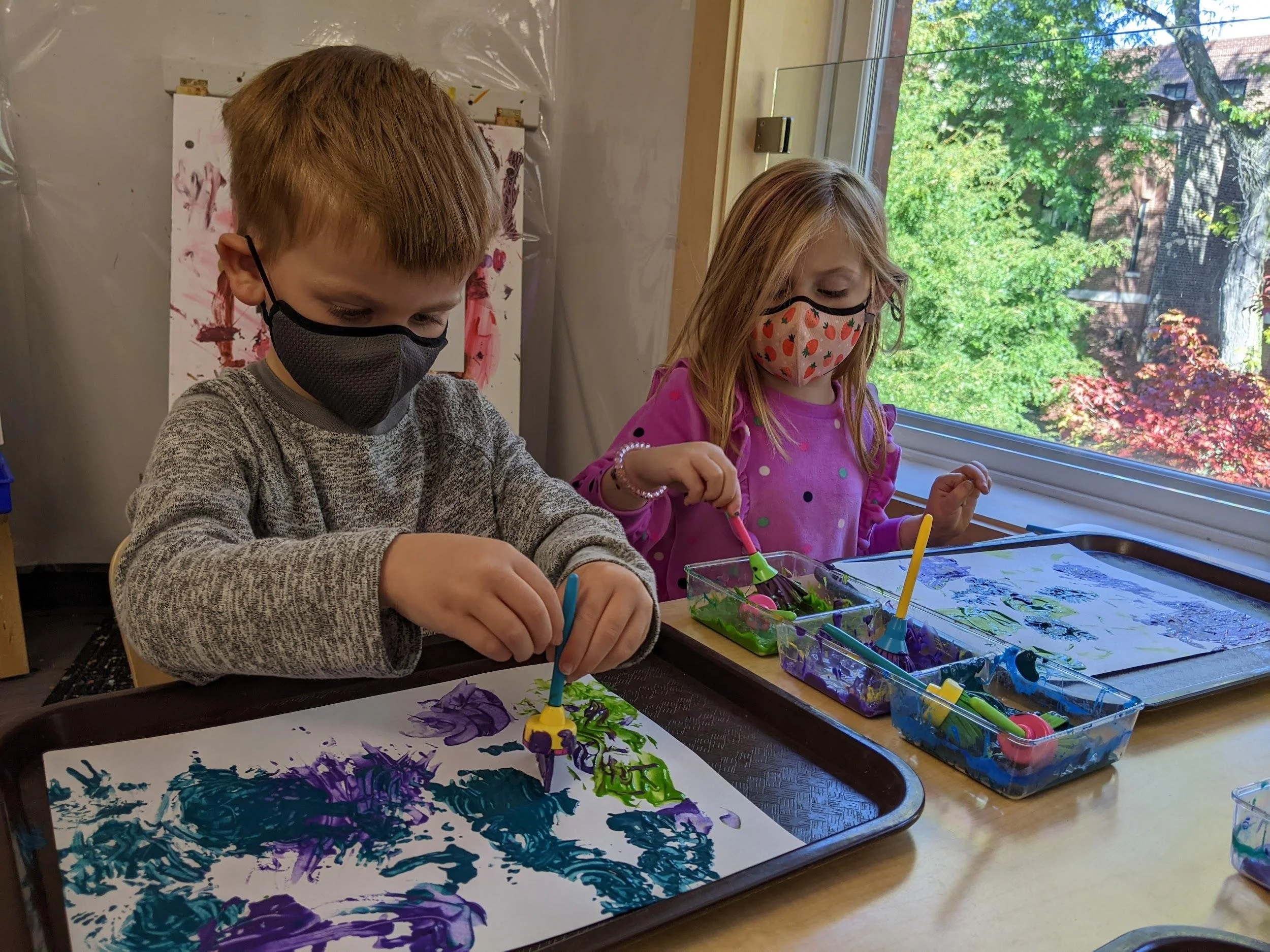
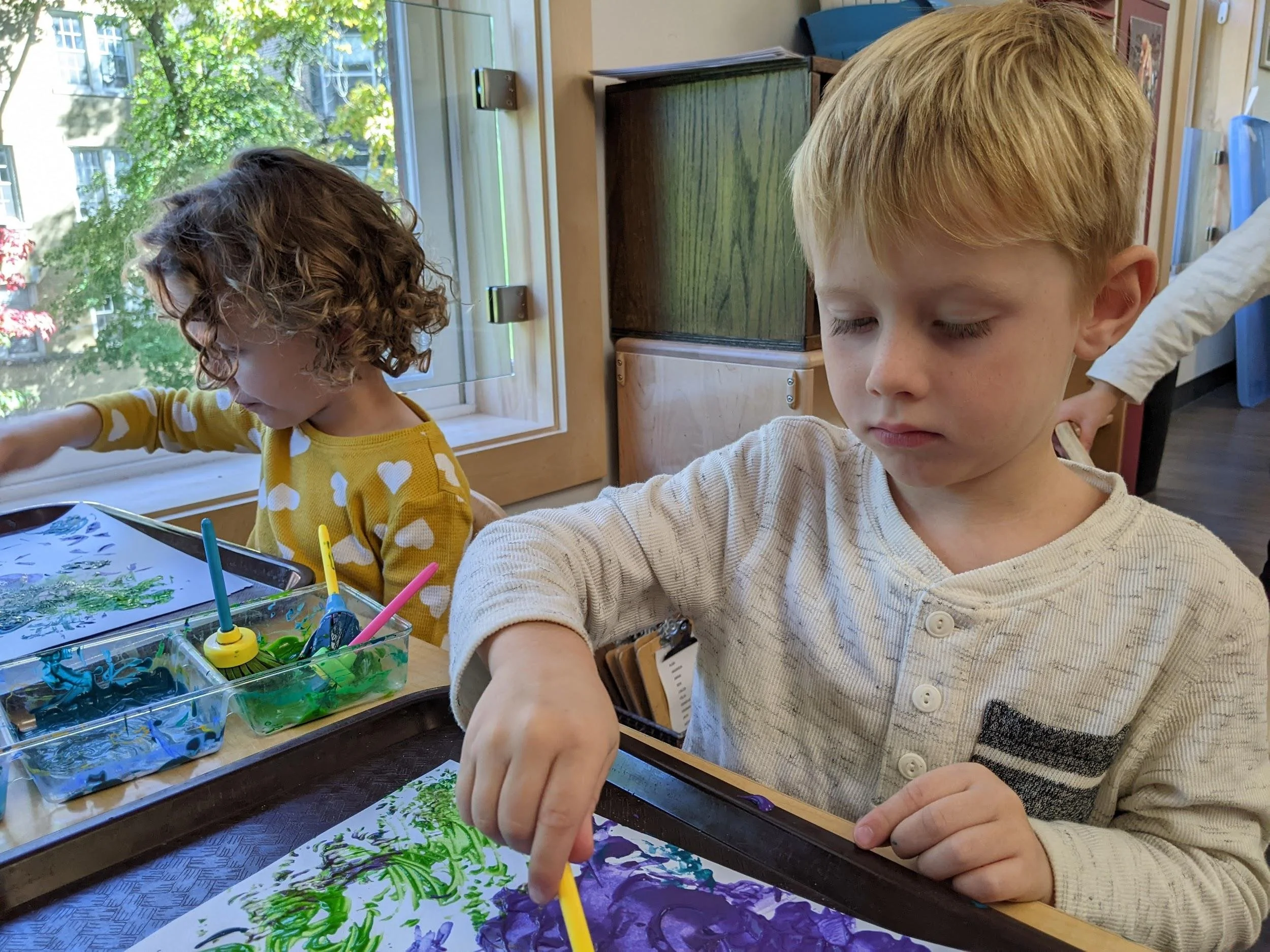
It has been a busy week in JK! Children have worked on a large-scale painting with tempera cakes at playtime. This type of paint is similar to watercolors in that one must dip a brush in water before swiping it across the tempera cake and then transferring that color to the paper. With multiple colors available, it then becomes important to rinse your brush before trying a new color. Tempera paint is thicker and more opaque than watercolors and creates a different effect. Since the rinse water can quickly get dirty, children sometimes have the inclination to paint with the rinse water and need a reminder that first putting their brushes on the paint cakes will yield stronger colors. It can also be a challenge to remember to rinse the brush when changing colors. Children managed these procedures well and have been excited to see the beautiful mural-sized paintings that we all made together.


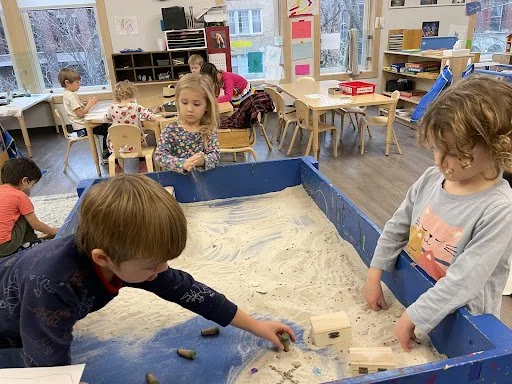
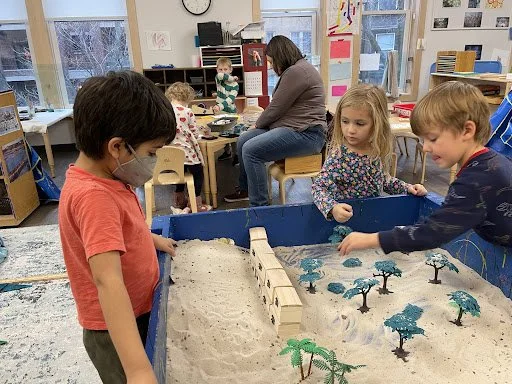
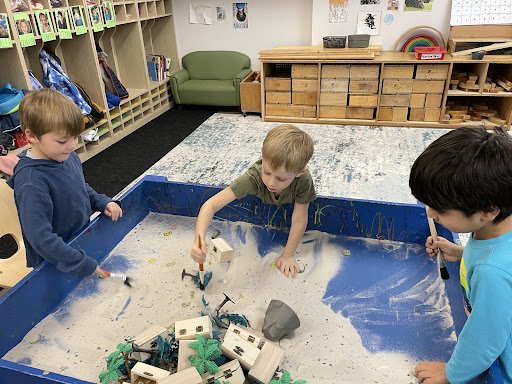
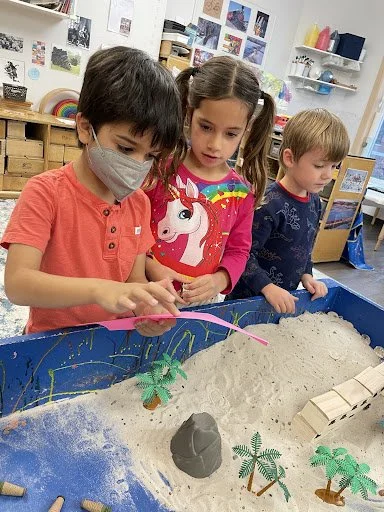
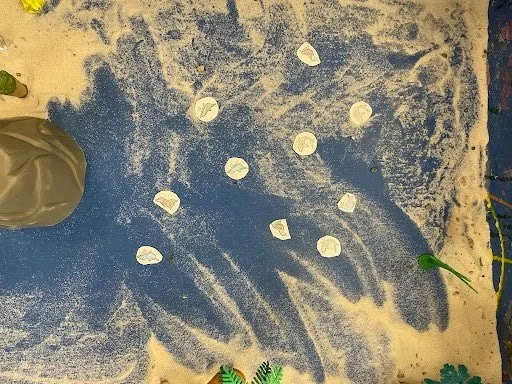
In our sand table, we added small wooden chests with gold coins and gems. Children began to collect and bury treasure and mark the spot in which they buried it. When they began, each child started by making his or her own hiding spot, but as the play continued, they started to notice each other’s ideas and collaborate. When someone decided the blue bottom of the sand table looked like water, they worked together to create islands on top of the water.

Dry brushes aided in clearing sand off the bottom of the table. Then, they decided they needed trees for the islands and fish for the water, so teachers got some trees out and helped make some paper fish. There were countless discussions about where to place items and why. Some had ideas about highlighting the places the treasure was buried while others wanted to better define the islands or make the scene more realistic. Several children created maps of where their treasure was buried and eagerly explained them to classmates. We are excited to see how this play evolves in the coming days.

Highlights from JK-E

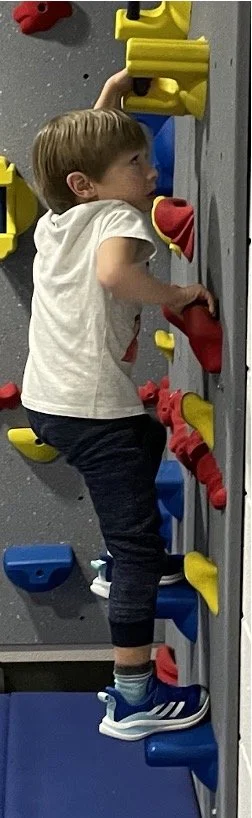
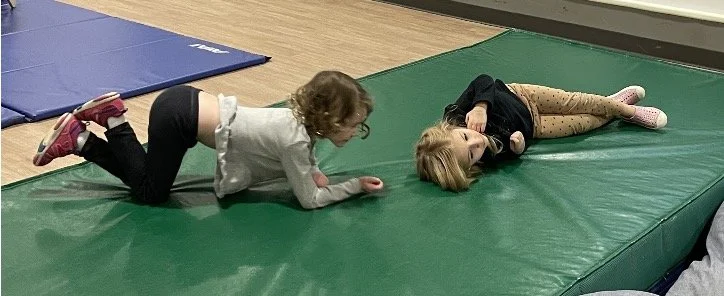
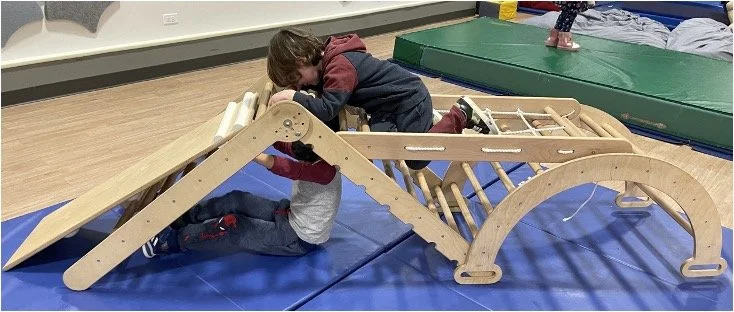
JK Kids jump, climb, roll and role play in the gym as they explore gross motor activities and  enact stories about families, superheroes, pokemon and animals. 

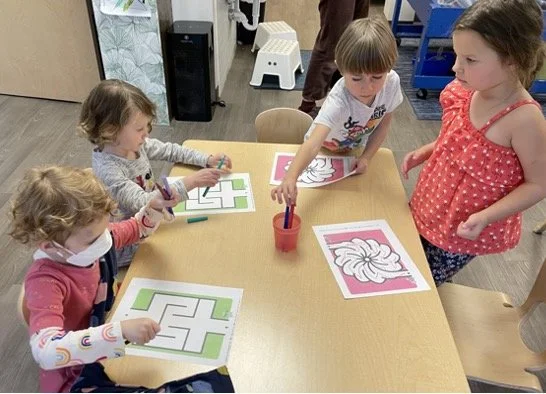
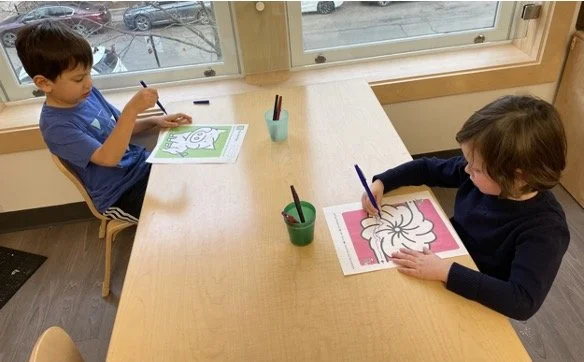
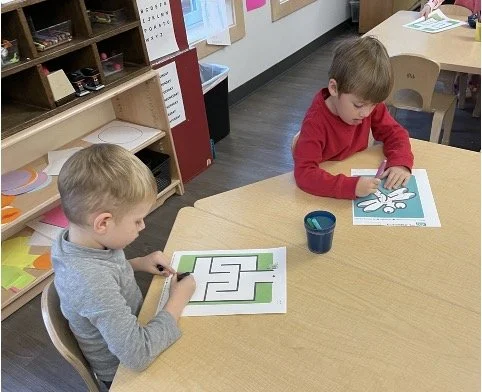
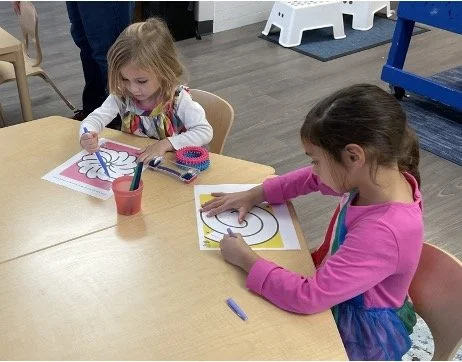
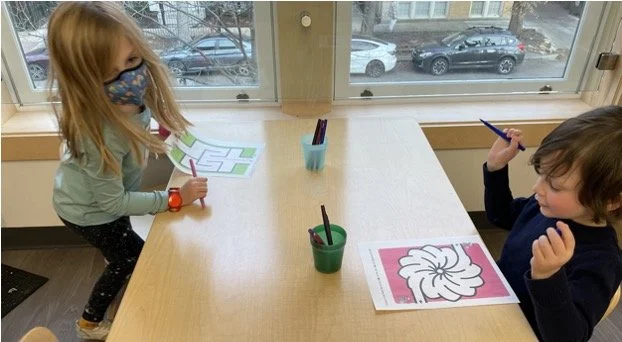
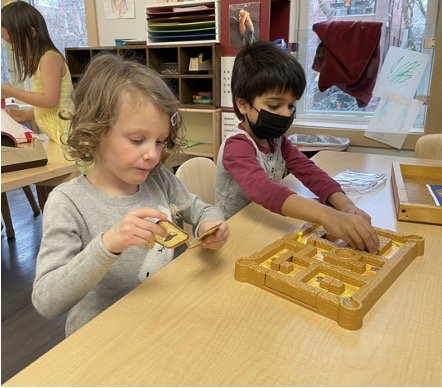
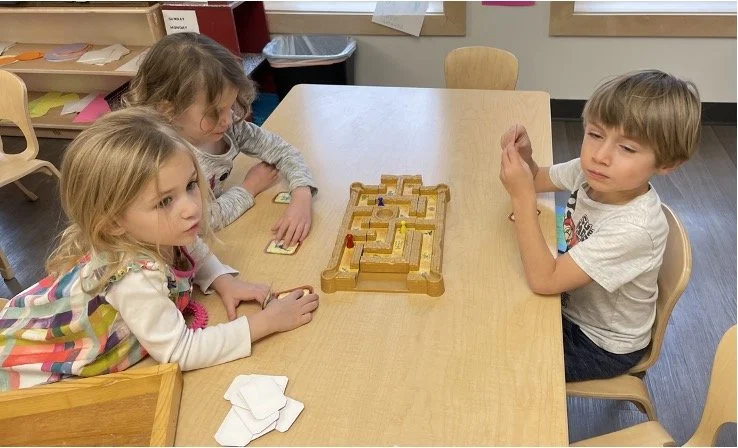
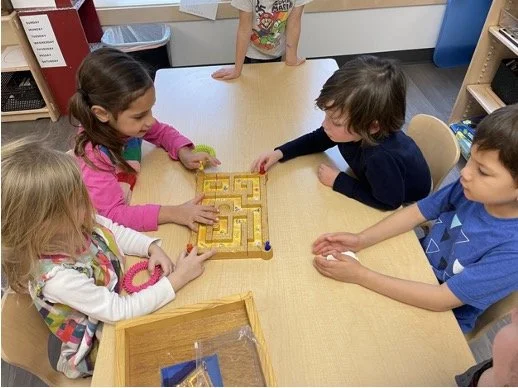
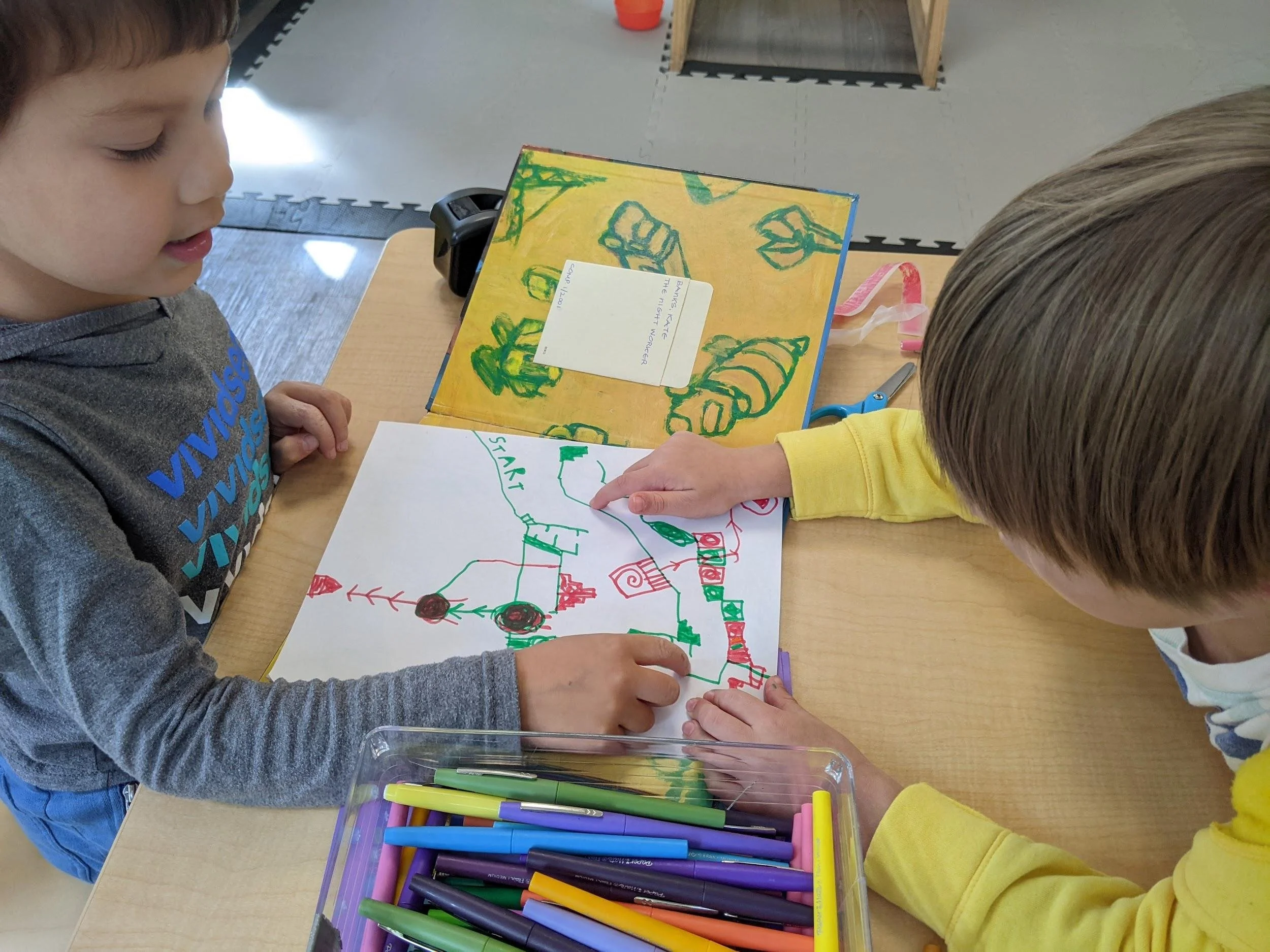
In the classroom, we explored mazes during table time and then introduced a maze-based board game for children to explore.

Announcement + Car Wash

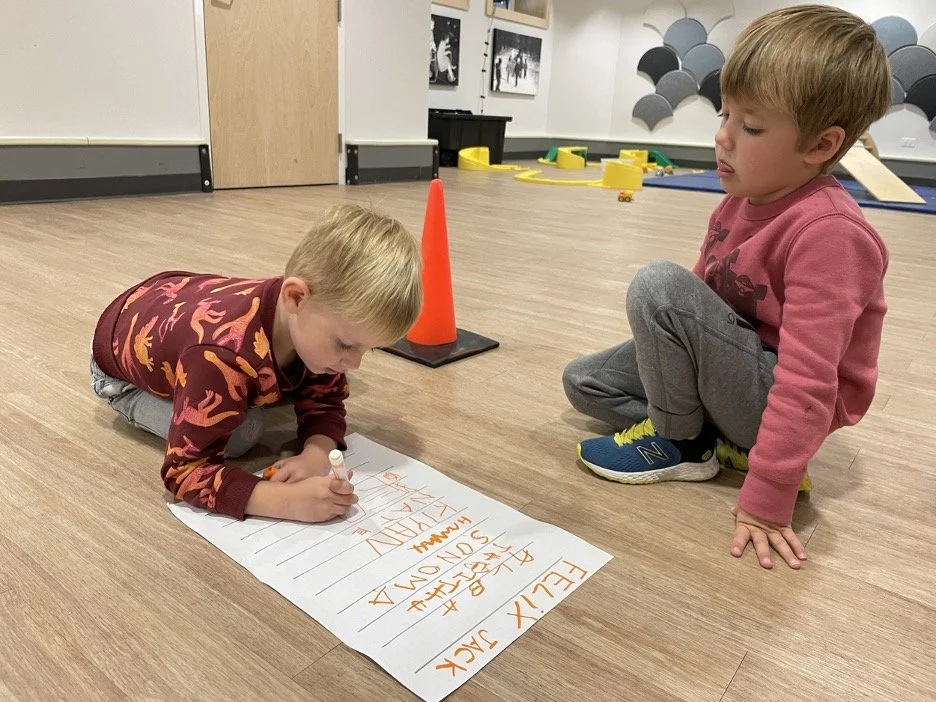
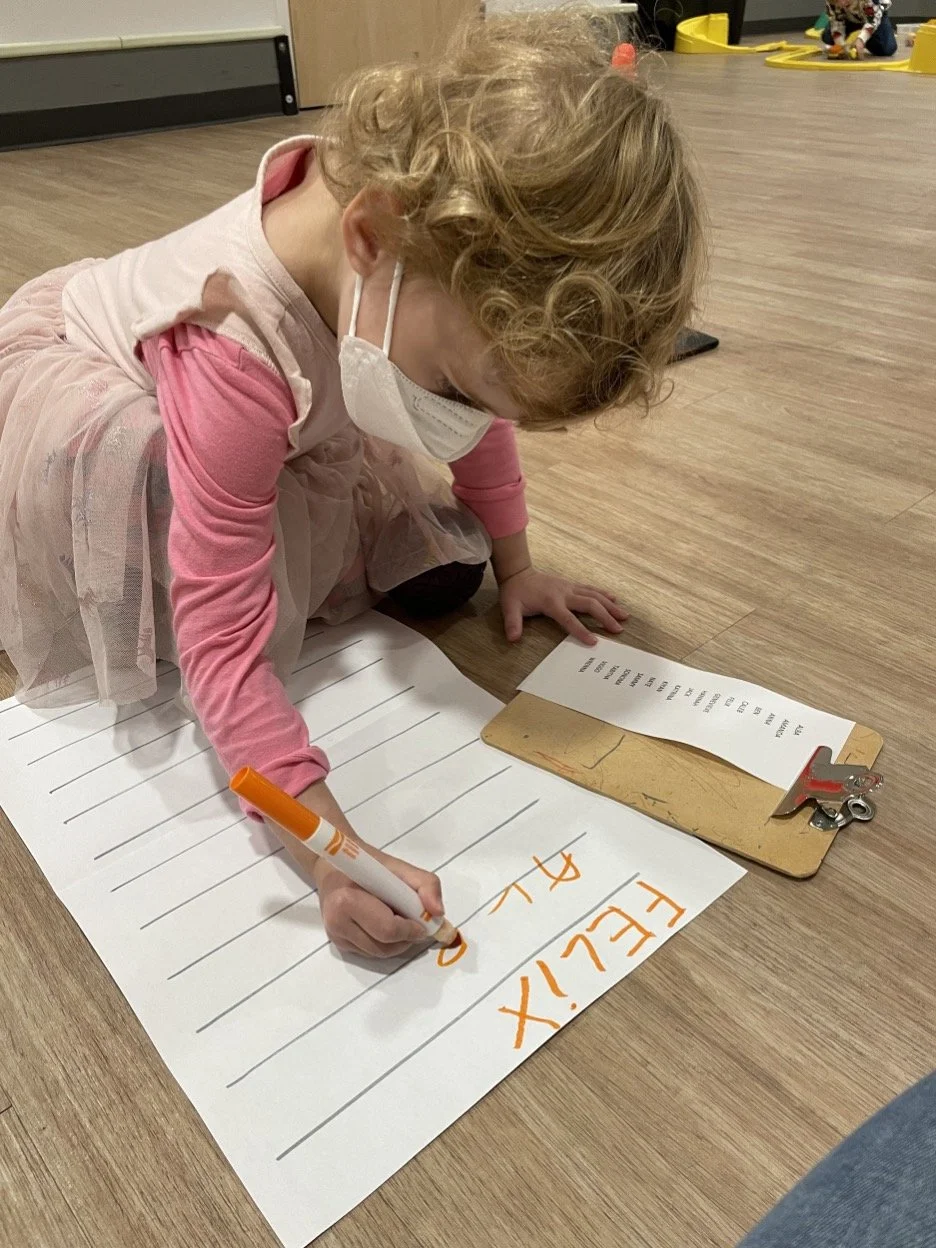
Our classmate, Felix, will no longer be attending JK at Park West. This week we offered kids in JK a chance to write him a letter or draw him a picture to say goodbye. We will be sending these letters and notes to Felix and his family. So long Felix, Marc, and Liz, wishing all the best, we will miss you!

Car Wash

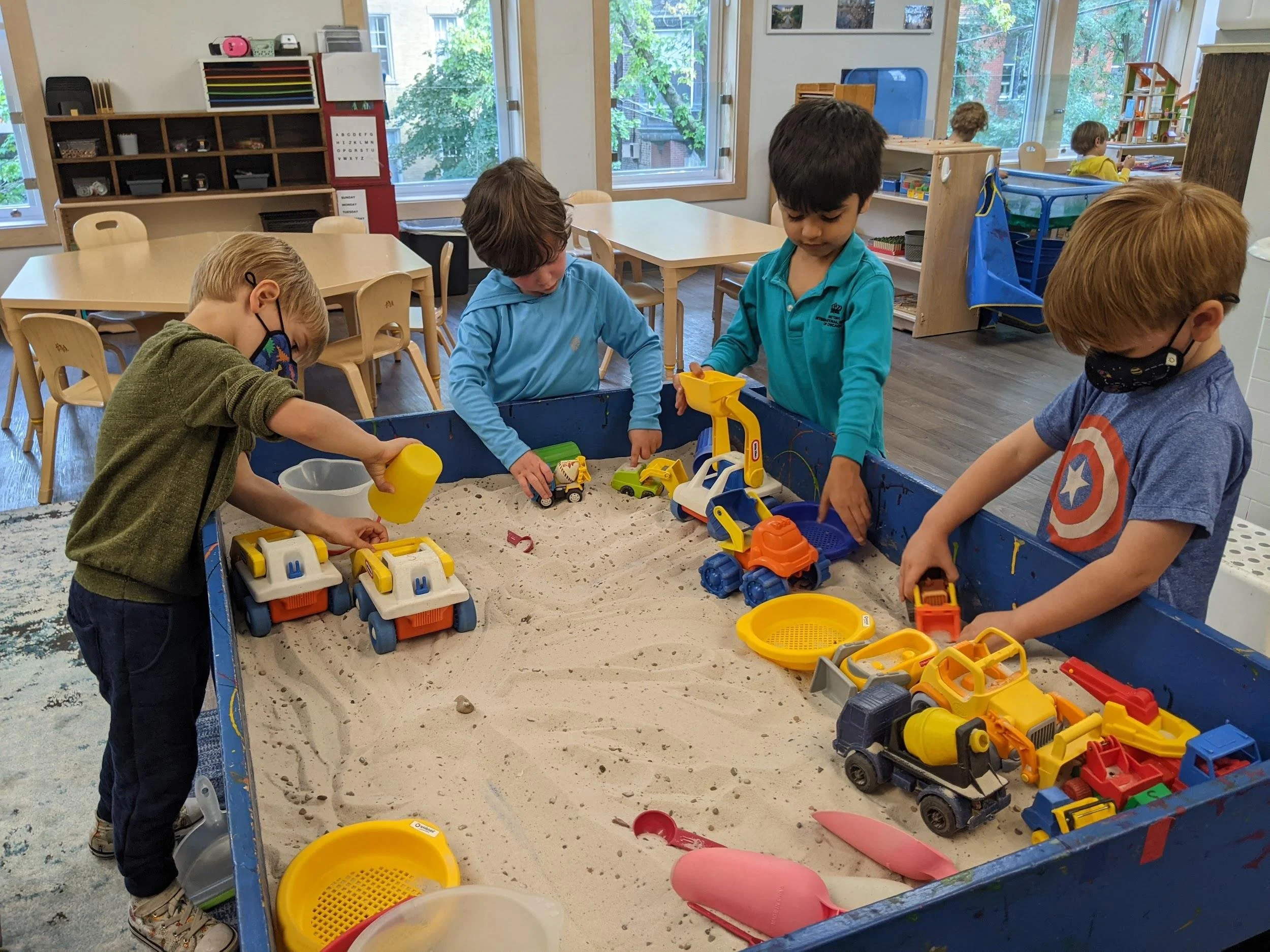
On any given day in the classroom, you’ll find many children playing with vehicles. We offer lots of different opportunities for this type of play, and children approach it in a variety of ways. While some build roads and bridges for their cars to drive on, others enact a variety of fantasy games in which cars race, buses drive people around and dump trucks are repeatedly filled then dumped. Vehicle play offers many opportunities for growth as children explore a variety of physical properties, act out familiar scenarios and negotiate materials and ideas with other children.

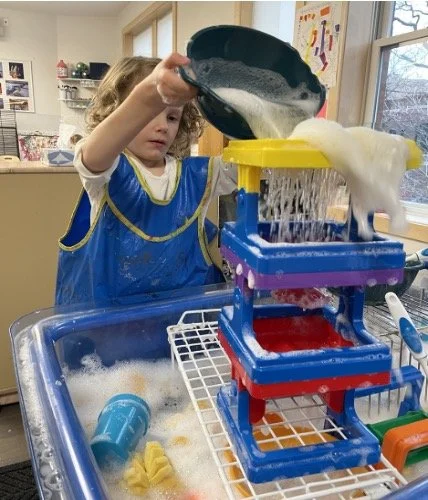
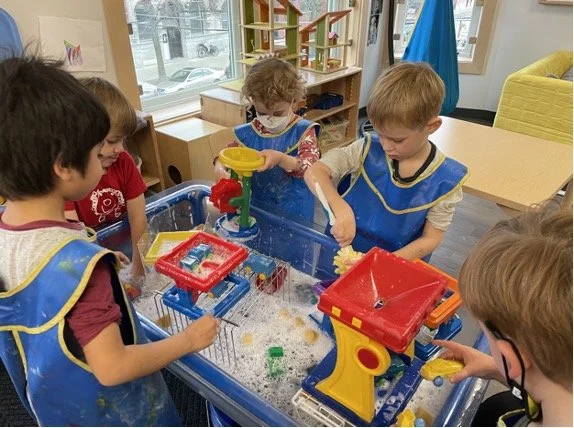
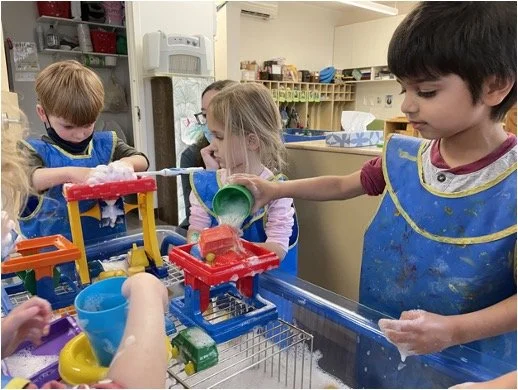
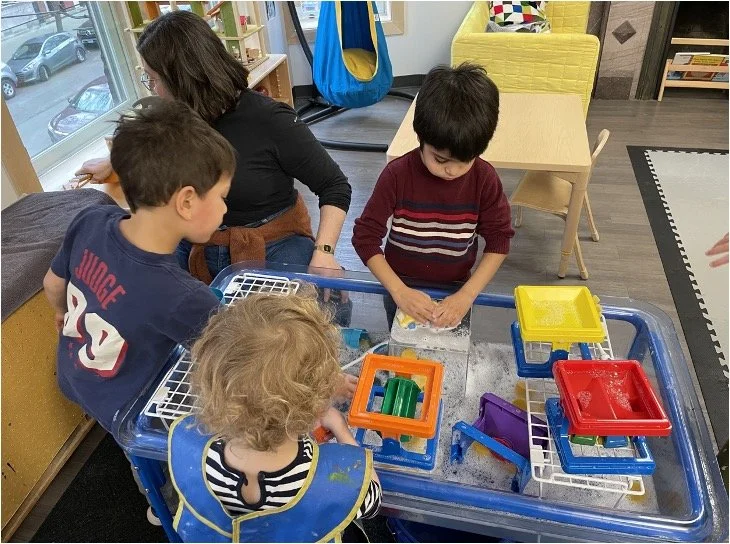
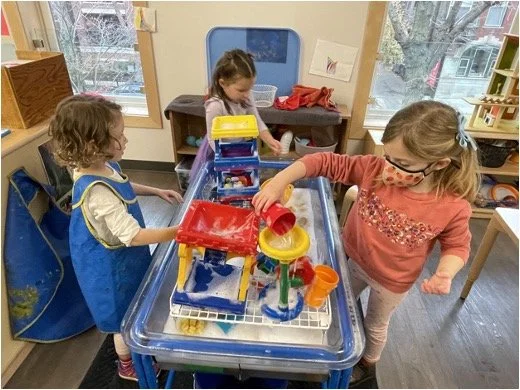
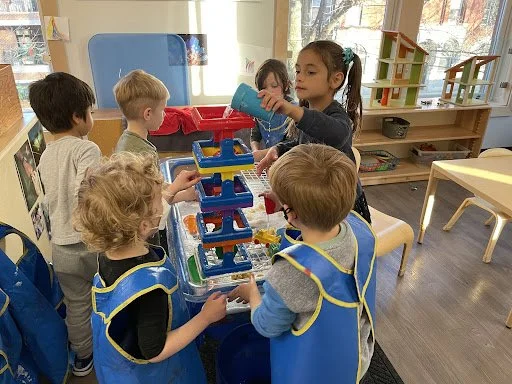
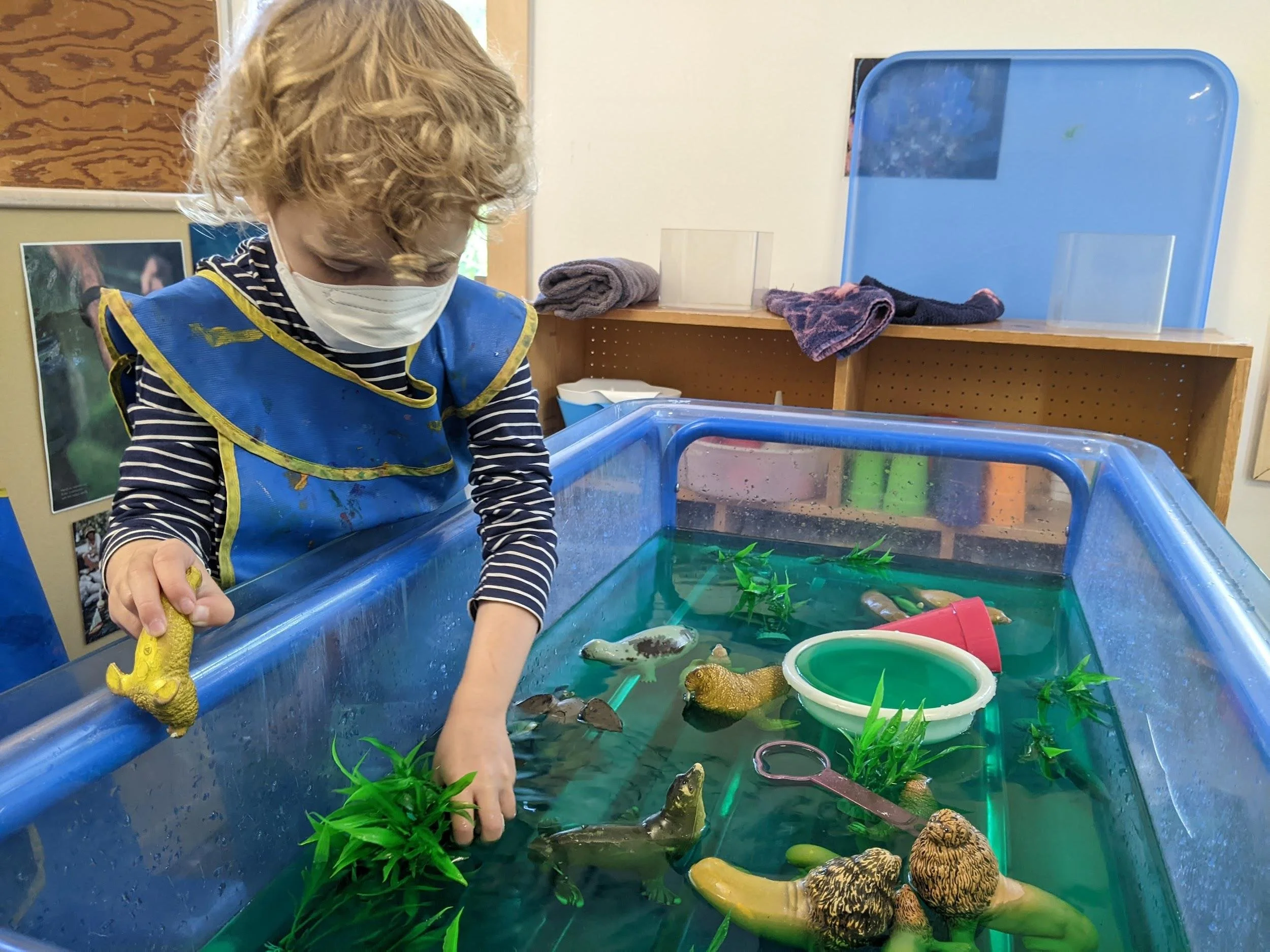
This week we added vehicles to the water table along with sponges, brushes, soapy water and water wheels and sieves.

Children have enjoyed exploring this car wash set up, using sponges and brushes to wash cars as well as pouring water over the wheels and sieves while cars are underneath, getting cleaned. Some have been engaged in stacking wheels and sieves while others are diligently wiping down cars or squeezing soap bubbles out of sponges. This arrangement has inspired conversations about cleaning, observations about soap and bubbles and collaboration between children as they establish procedures around washing cars.

A new fishy song + Literacy Development

We taught a new song, also recorded by another teacher a few years ago:

3 Little Fishies and a <insert grownup (Daddy, Mommy,etc)> Fishy, Too

Literacy Development

Many kids begin the school year telling teachers they do not know how to write their name when we ask them to put it on a painting or when they want to sign up for a turn.  We encourage them to make any marks they do know, to “show us how you do it.”  Then, we might ask if we can do it the way we know next to theirs, so they can see the standard shapes of the letters. 

On another occasion, we might bring their cubby tag over so they can look at the letters and try to make the same kinds of marks, or draw dots for someone to connect to form a particularly tricky letter.

 Sometimes, someone needs actual physical support, a teacher’s hand over theirs, to have the confidence and/or physical strength needed to try to make a mark.  Each time someone tries, the challenge is less daunting, and eventually kids are writing names on lists and artwork without a reminder to do so.  Even if a signature is not a clear A-M-A-N-D-A, teachers get to know them and can decipher them most of the time.  We read these signatures aloud at group times, when recalling who has had a turn and who is waiting for a turn, who is next for an activity, demonstrating that all that hard work is worthwhile: the grown-ups can read what has been written.

This is the beginning of understanding the value and meaning of a complex system we use (and often take for granted) everyday.  Literacy is not simply memorizing the alphabet and having phonetic awareness.  We cannot simply transfer reading and writing to children.  We must create literacy-rich environments and provide myriad opportunities for potential breakthroughs in understanding and skill.  The ability to read and write is strengthened by a desire to read and write.  That desire is deepened when confidence is acquired in a stepwise fashion, and when activities are presented in approachable tasks. 

Eventually, we begin to discern who is ready for more than their own name.  We might suggest they write their friend’s name on a drawing they’ve made for them, or someone may ask us how to spell MOM for a painting they’ve made especially for you.  We might ask someone to make the sign up list for BLOCKS and help them sound out B-L-O-K-S, an invented spelling that is a good first step in understanding the way letters work together.  Children who want a teacher to read a favorite book to them each day may one day be encouraged to read it to their peers, and when they say they do not know how to read, a teacher will remind them they know the story and can read the pictures.  Another step in the larger process. 

Eventually, children will begin to notice letters on street signs or in the grocery store, begin to decipher APPLE on a sign or ask to write CUCMBR (again, invented spelling, to be encouraged) when they make a menu for the playhouse kitchen. 

There will be starts and stops, stalls and staggers in this process.  Everyone does not do it at the same time, and something that seemed to be solidly understood may seem to suddenly disappear as one’s focus shifts to another area of development.  Between 2 and 5 years old, we are all taking in so much information and developing very quickly.  Teachers do not expect to see a straight developmental line, but recognize that the path will be individual and lots of things will spring up along the way, all worth exploring and beneficial for building a well-rounded understanding of the world.  It’s all interconnected.  Group life, our classroom group in this case, offers a good lens for seeing just that.

Fold Painting

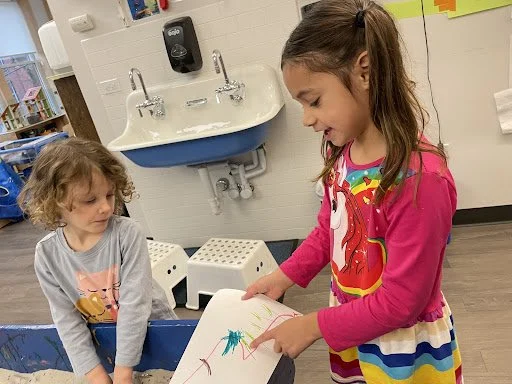
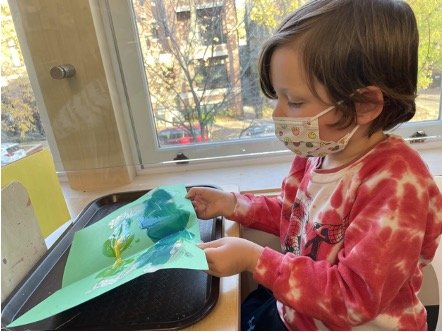
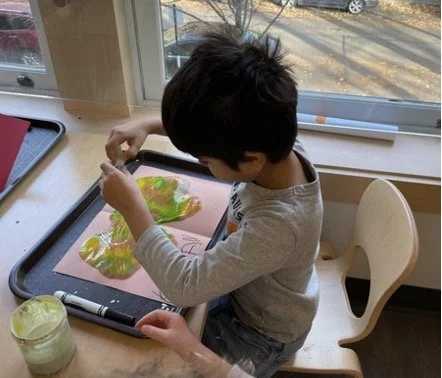
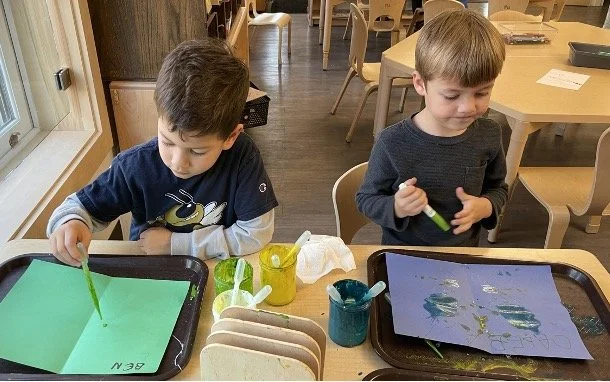
This week we introduced fold painting in Jk. For this type of painting, we offer kids a few colors of paint with pipettes along with folded pieces of construction paper. We demonstrated the process at grouptime. First, you open the paper. Then, you submerge a pipette tip into the paint, squeeze the pipette and then let go so that paint travels into it. Once your pipette is full of paint, you can squirt the paint onto the construction paper. Then, you can add more paint and include different colors. Once a painter feels finished applying color, they then fold the paper and press, spreading the paint. After this, you can open your paper and see your design. Fold painting creates a mirror image and blends the paint colors in interesting ways.

JK kids have been excited to give fold painting a try. Just using the pipettes can be tricky, especially with thick tempera paint. The pipettes allow a limited amount of control in how much and where the paint is applied. Many children have enjoyed sucking the paint into the pipettes, experimenting with squirting the paint onto the paper, deciding where to apply the paint and opening up their papers to see the final product. This activity offers opportunities to develop fine motor control, explore physical properties and express creativity. Many are dazzled by the beauty of their paintings and enjoy thinking about what they look like. 

We introduced some new activities/materials last week:

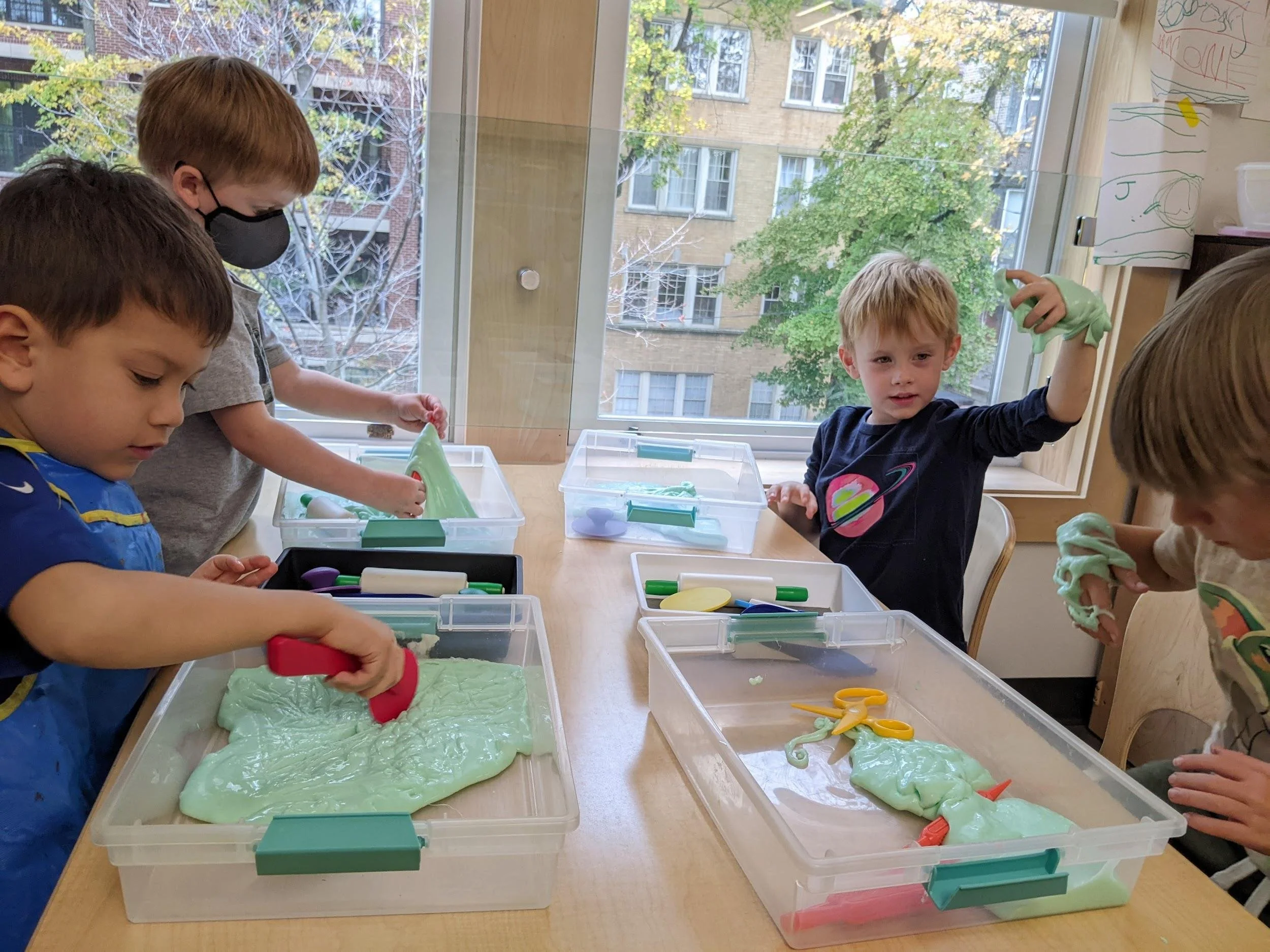
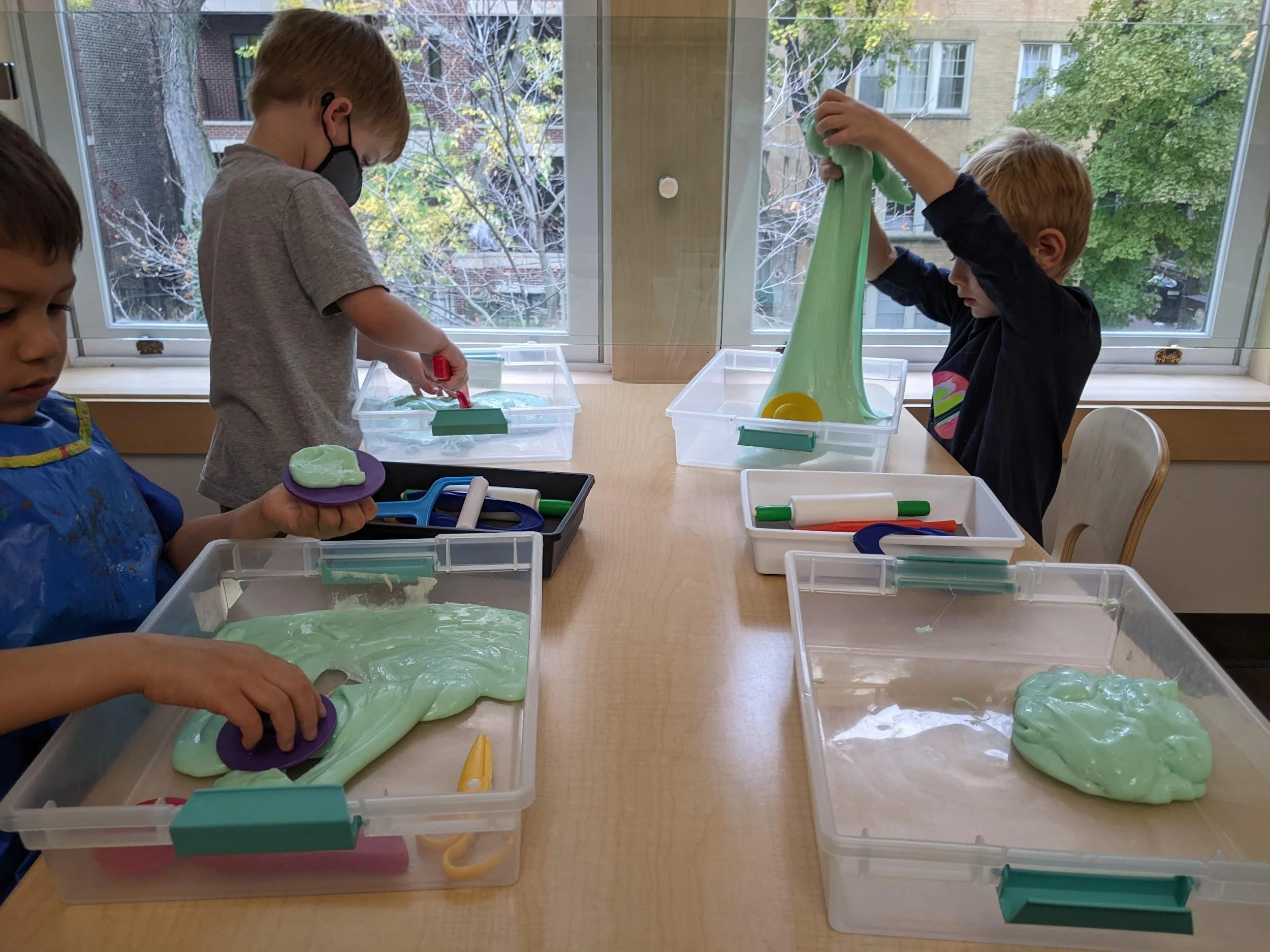
Silly putty is roughly equal parts liquid laundry starch and glue, plus a few drops of food coloring.

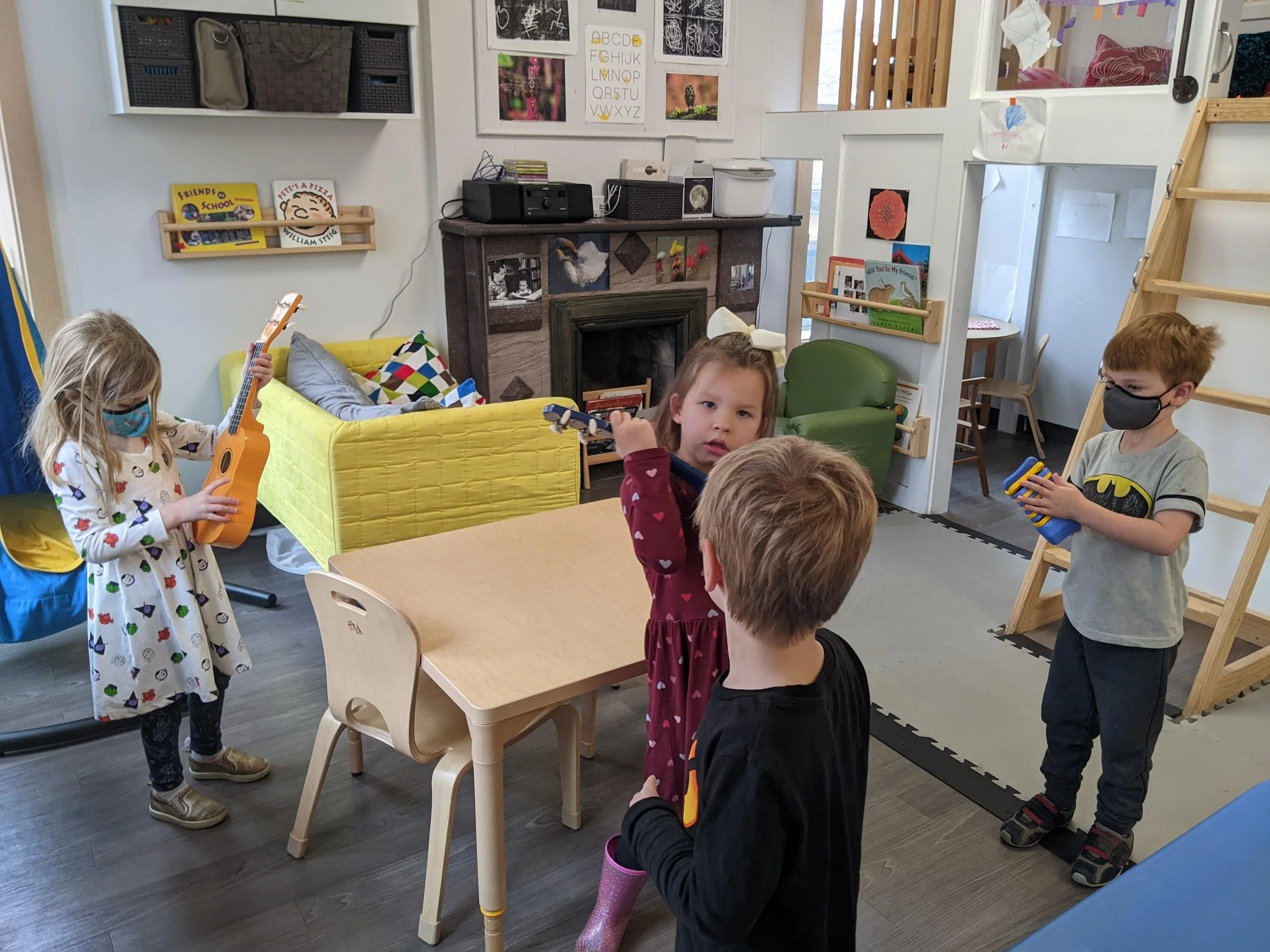
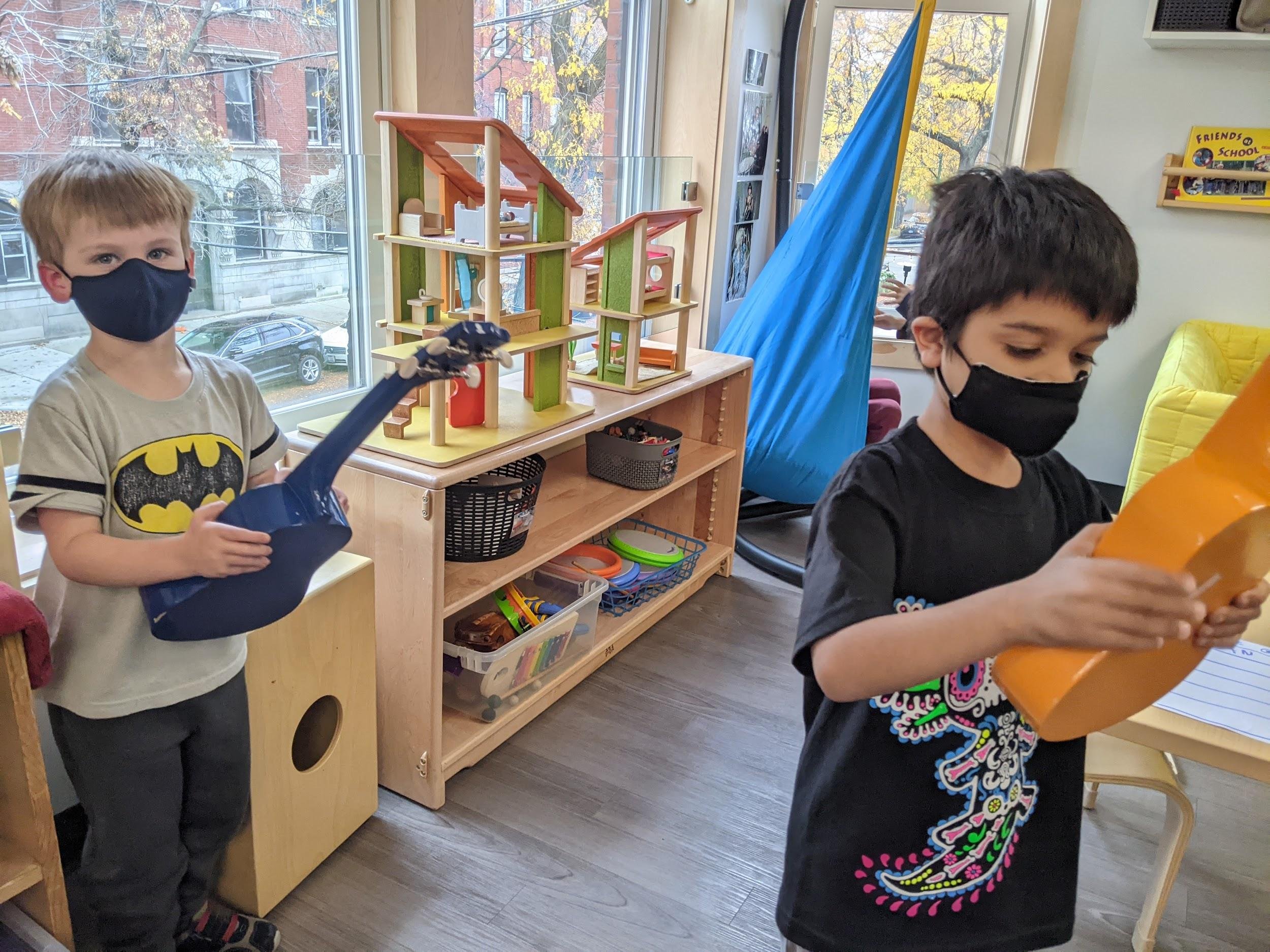
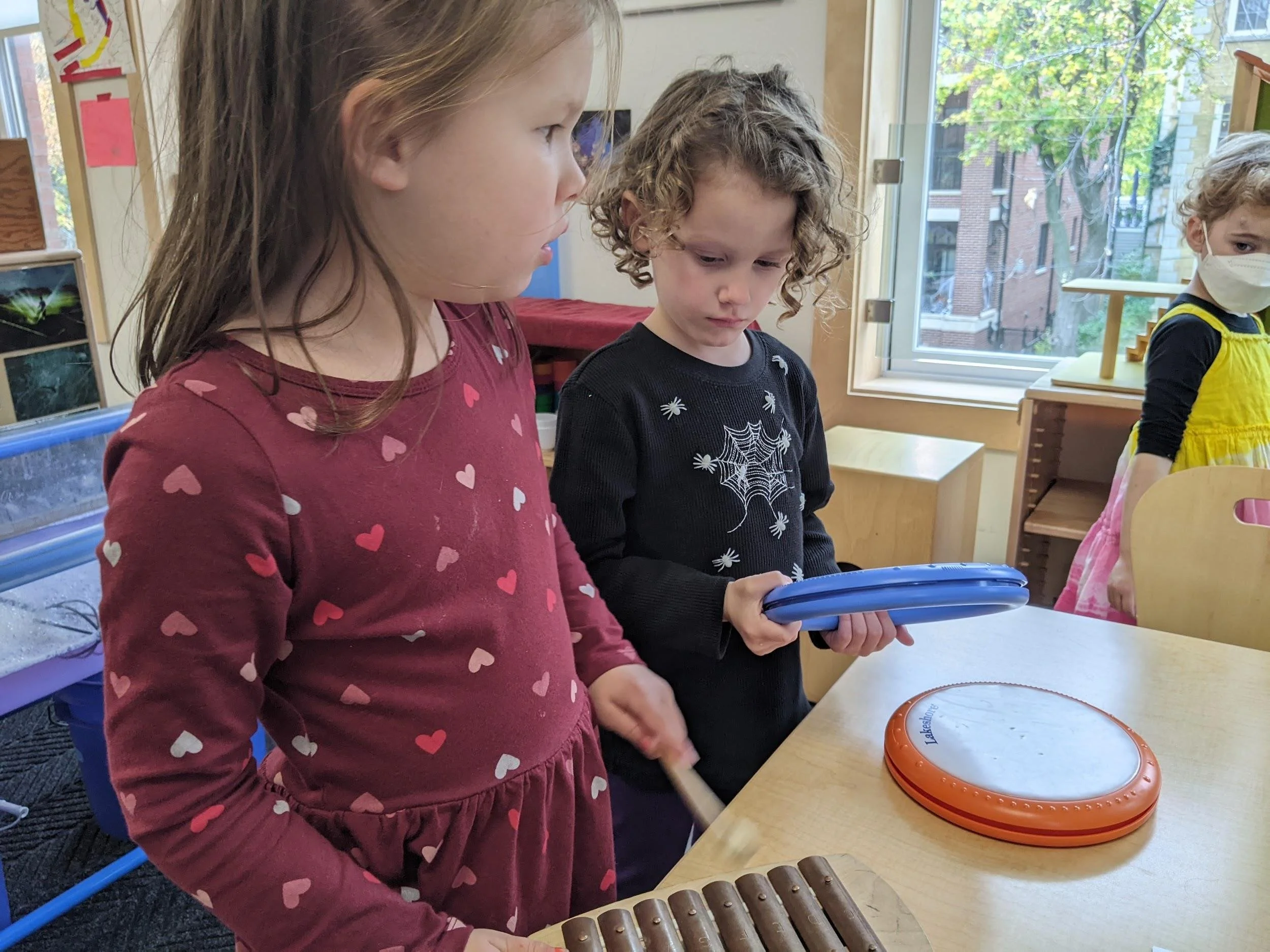
Musical instruments are available.

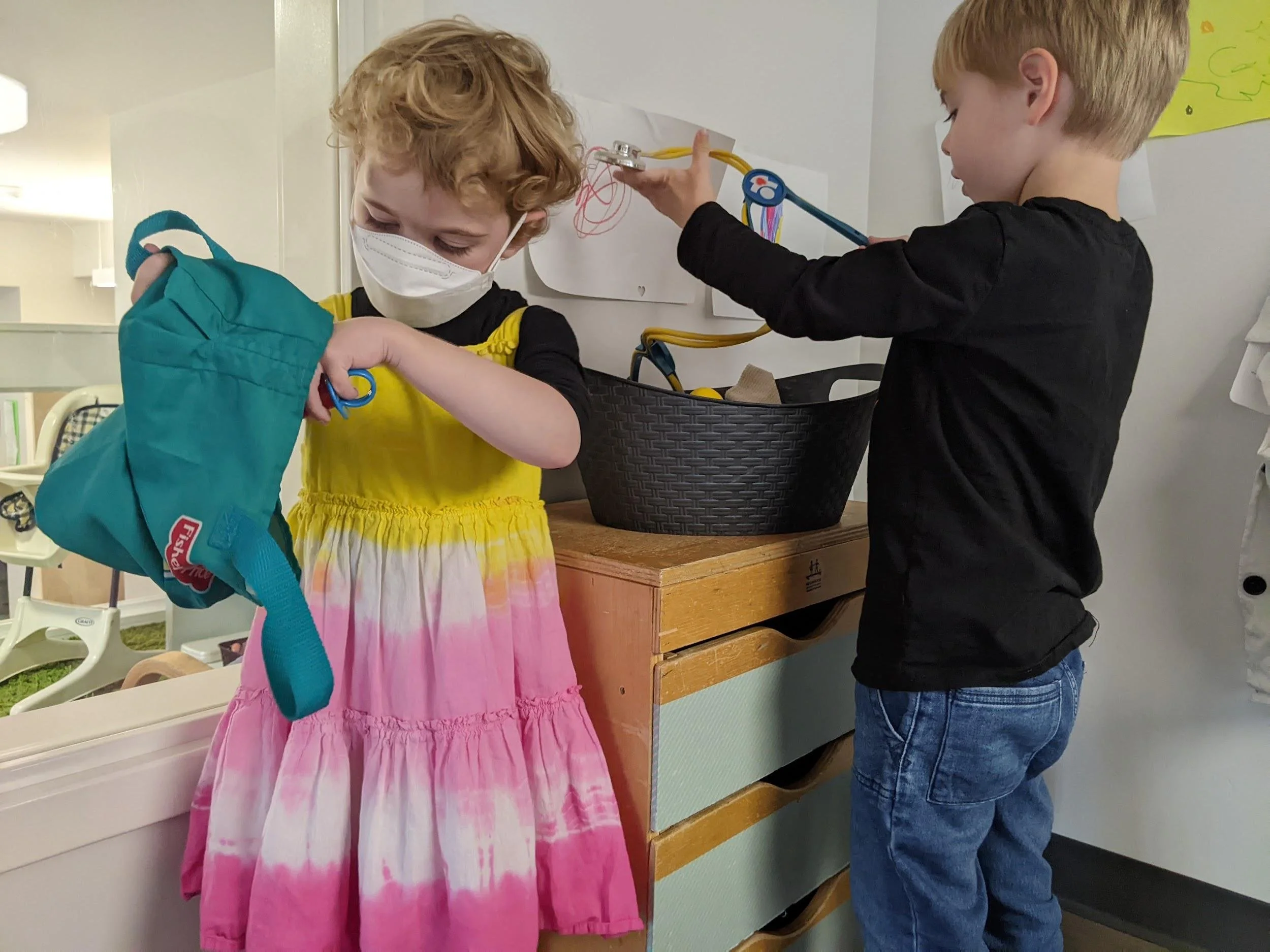
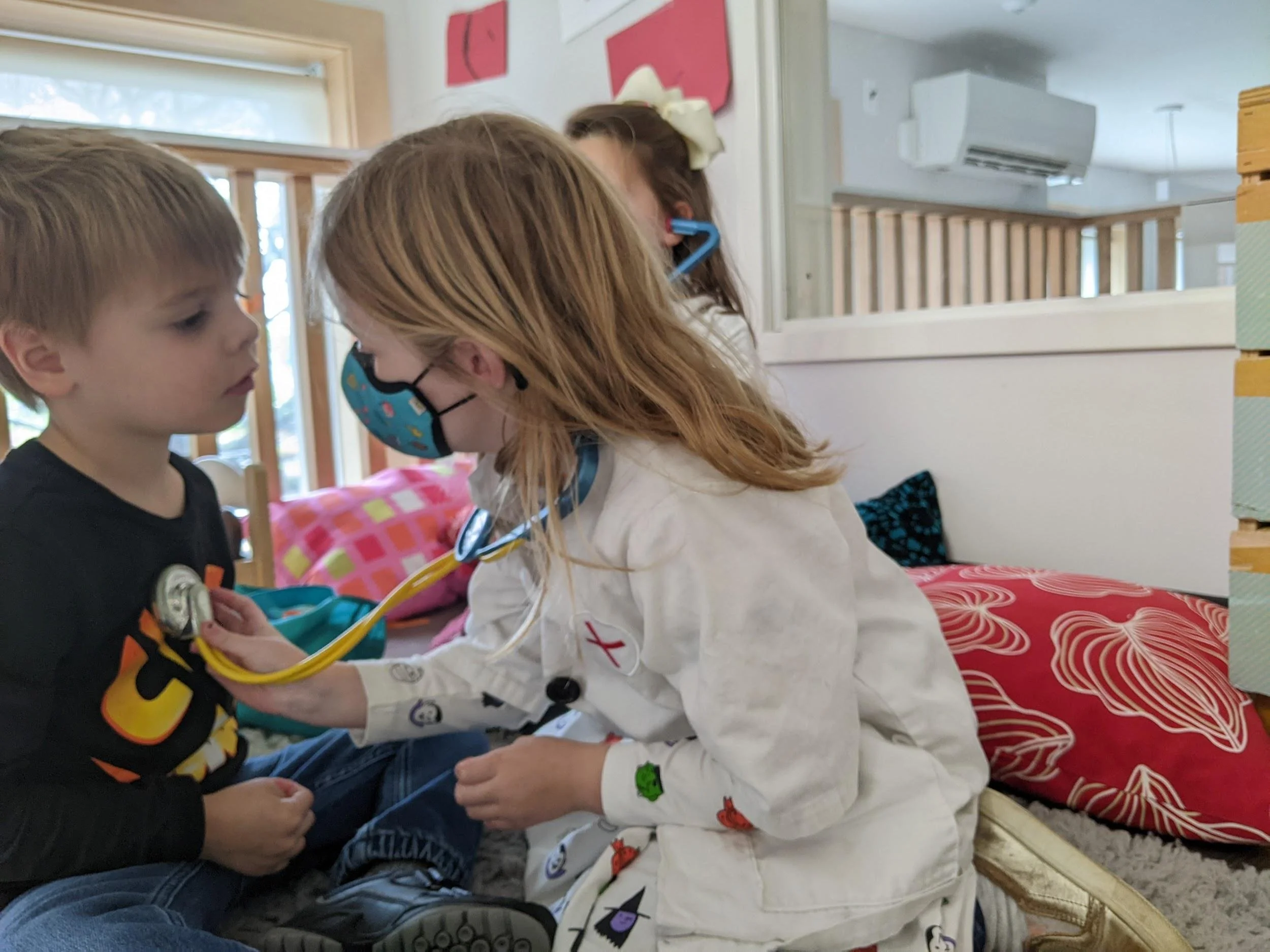
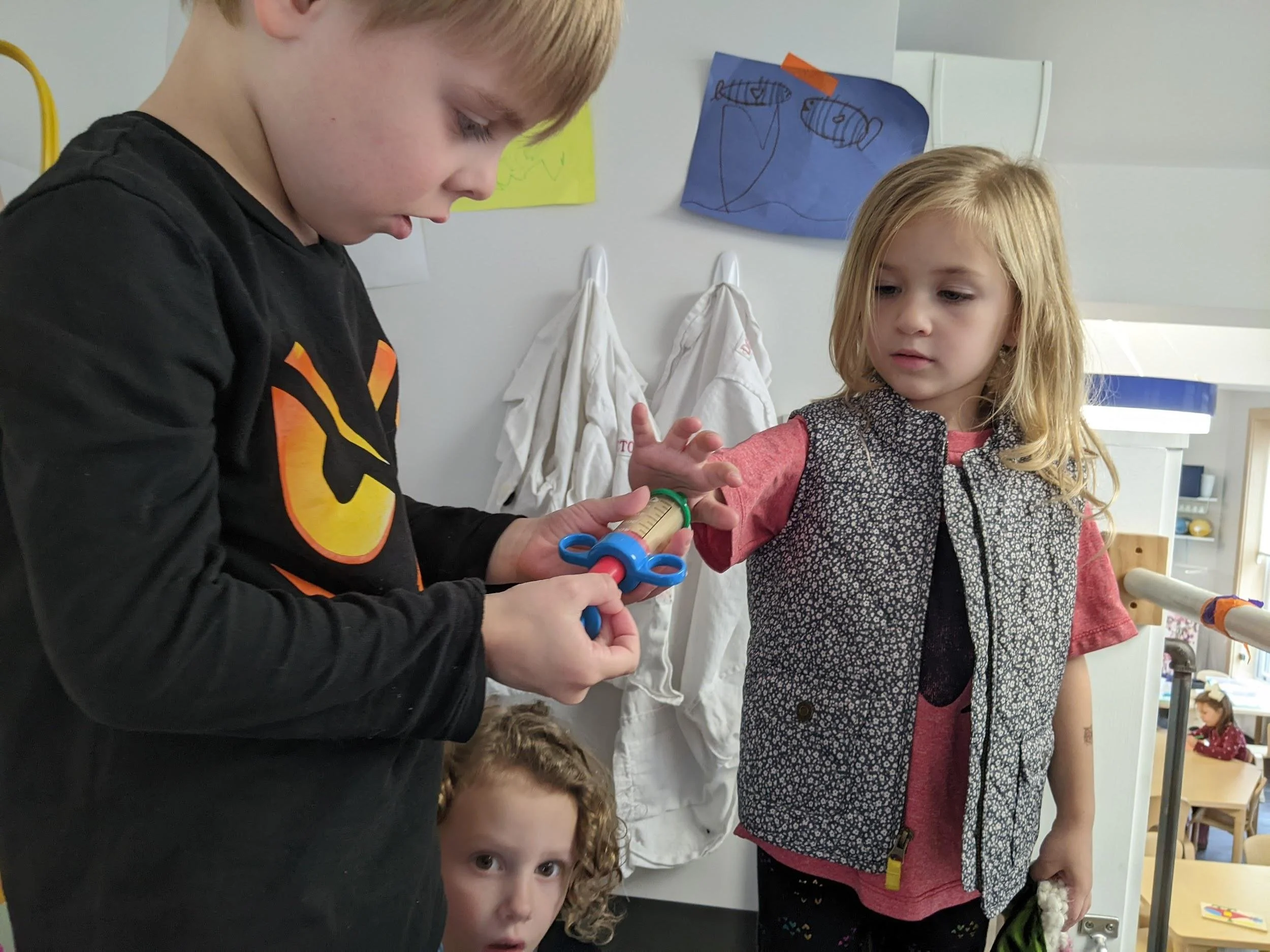
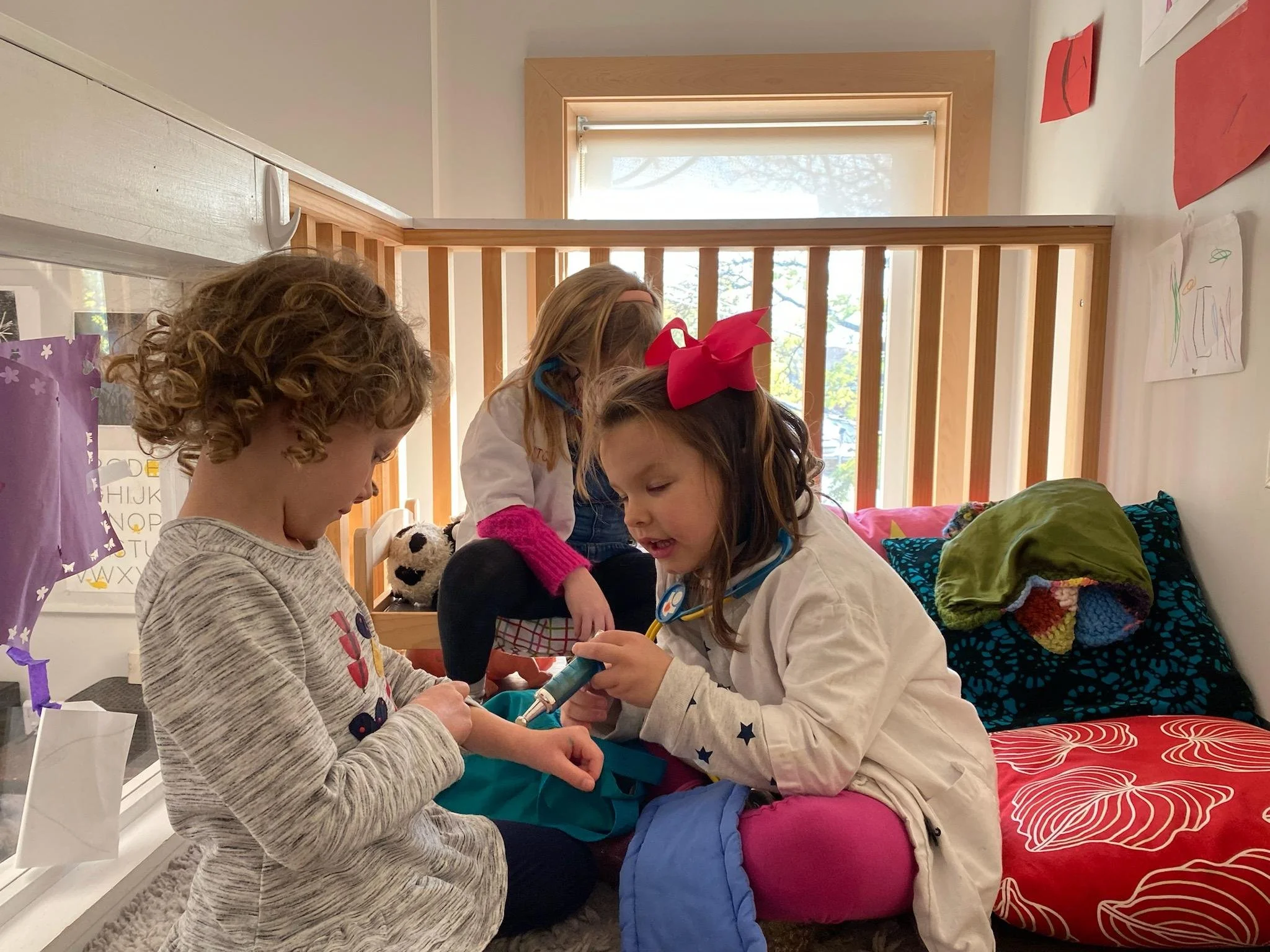
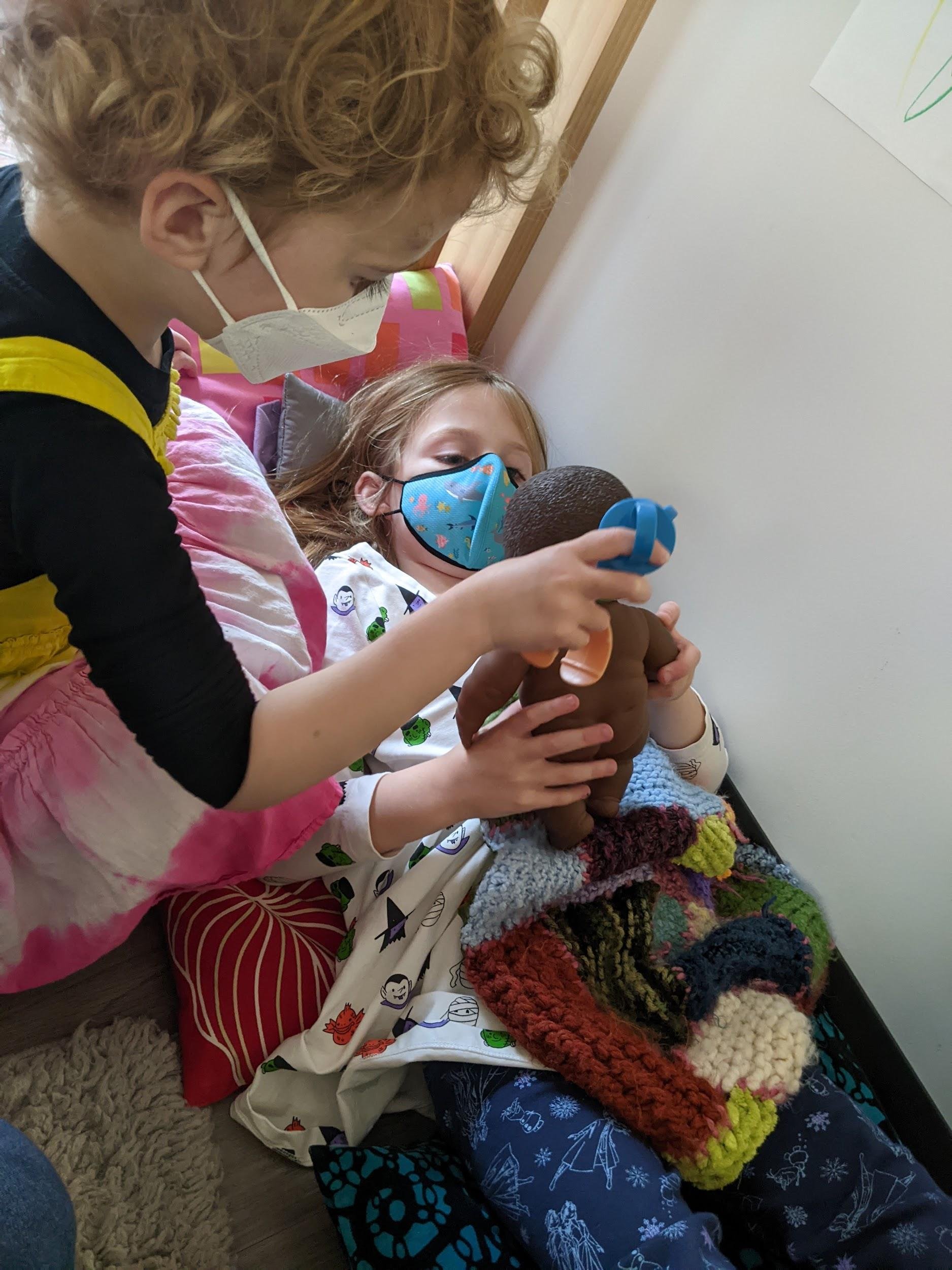
Doctor’s kits and jackets are in the play house. Children are caring for each other, teachers, our baby dolls, and stuffed animals.


Sharing, Taking Turns, and Protection of Work

We’ve heard of kids who have said, I know about sharing. That’s when my mom takes my toy and gives it to my brother! In our desire to encourage young children to share, sometimes we use adult ideas of fairness and niceties that don’t make sense or feel very good to children. If another child paints on your child’s painting, you might be inclined to say, It’s ok! We can all share. But, think about how you would feel if your work was interrupted by another person who changed what you were doing. You would rightly be offended, and your child has the same right to protect their work from others’ interruptions.

Intentions are good. We want our children to be able to share materials, play together, and consider others’ feelings as they work cooperatively. We share those goals, too, but at Park West we take a different approach. We use a system we like to call Protection of Work. We try to protect children’s work while instituting a system for turn-taking that ultimately helps kids manage this on their own.

So, what to do when your child is the one so badly wanting that turn? First, language can help a lot. We encourage kids to ask for a turn. In the beginning, this means teachers are saying all the words, but this modeling gives kids an idea of what they can say: Can I have a turn? Are you done? Now the first child can decide if they are finished with the toy or not. If a child grabs a toy from another child, teachers may say: Look! She is using that truck right now. She was holding it. Let's ask her to tell us when she is done. Then we will go ahead and talk to the child who is using it. These exchanges enable everyone to see just how this process works. A way to support kids during these kinds of exchanges is to help the asking child find something to do while the first child finishes their turn. We also make sure to follow through when the first child is finished. Do you remember who wanted a turn? Let’s tell her it’s her turn, now. 

Sometimes teachers do need to help move the turns along, especially if the first child has been using a coveted toy for a very long time. We will remind the first child that their classmate is waiting, or help the classmate ask again, and express that it feels like a long time to wait for a turn. Ultimately we want children to start to consider other children’s points of view and get the idea that this system works, whether they are the one desirous of a turn or the person trying to execute their idea before relinquishing the toy to a classmate. 

Sometimes teachers might adjust the approach, depending on the kids involved, the materials, and the particular situation. Everybody might want a turn with a new toy in the classroom, so teachers might help orchestrate shorter turns until the frenzy dies down. At some point, we might use a sign up sheet to help track all the kids who are waiting. At other times, a child may need a little more time to finish their turn, even if it means the child waiting has to wait until the next school day. What’s important to us is that these different approaches all can further the trust that everyone who wants a turn will get a chance and that there are people — parents, teachers, friends — who agree to this same process and will help facilitate it.

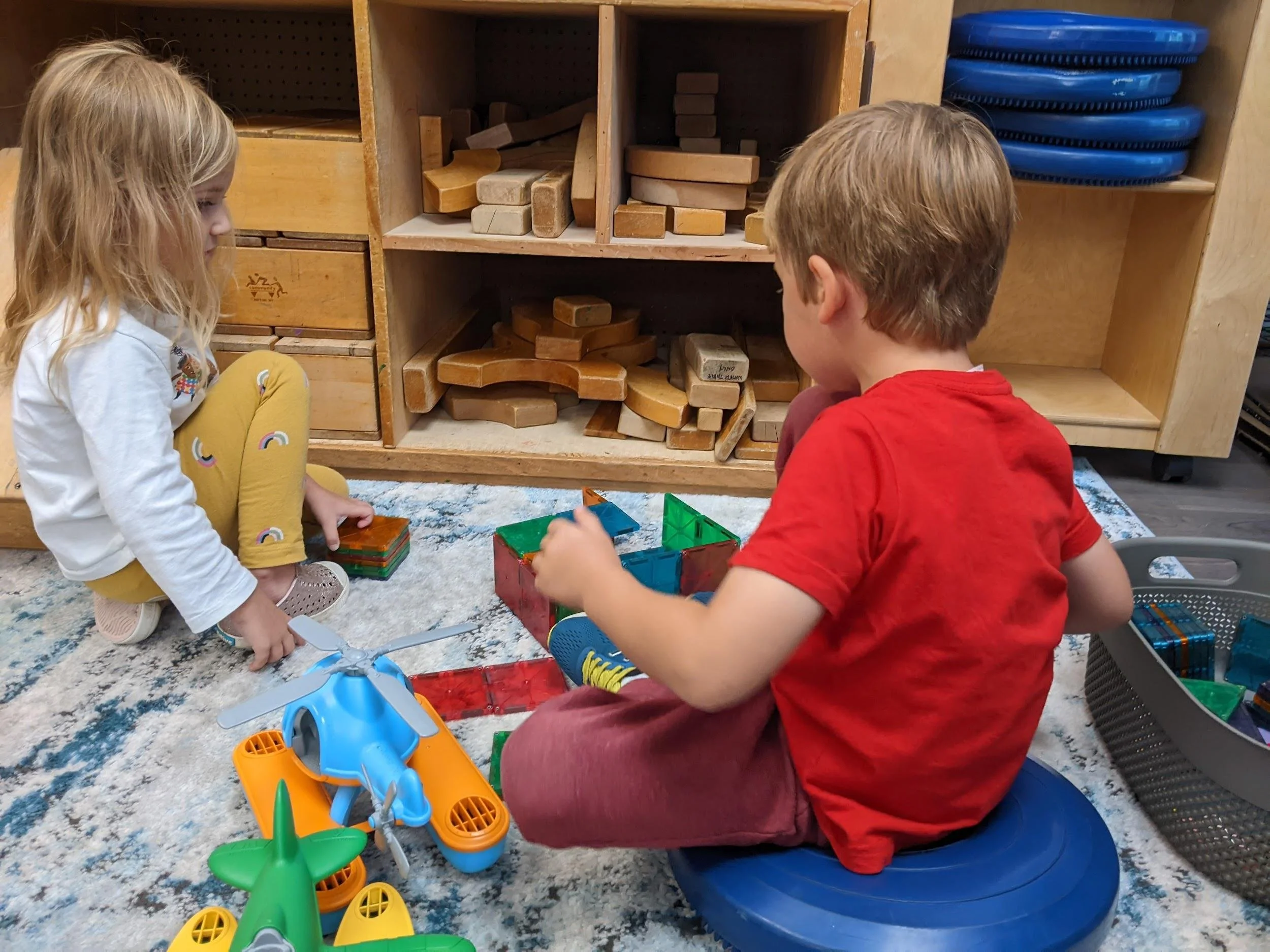
Materials like magna tiles usually have enough pieces for several children to play at the same time, but if one child is using all of the pieces we might point out, “You’re using all of them, and there are none for Alex to use. Which ones could she use?” Sometimes, Alex’s desires are specific so we might ask her, Which ones did you want? Then we’d help Alex ask for those. She may just need two more squares to finish the sides of her house. If the first child really resists, we might have to say something like, Can you give some to Alex, or should I help you? Children who experience this Protection of Work tend to relax when they realize that there is a system in place that works, whether they are the person wanting a turn or the person having the turn. After learning how to ask for turns, take a turn and let somebody know when you’re finished or not, children are freed up to use the materials. Once they know that they can ask for a turn, children begin to use the technique with kids in their families or in other venues. Parents can help siblings implement the strategy, even with toddlers who don’t really understand or have the words yet. Baby is using that right now. Let’s tell him you want a turn, and then wait until he’s done or I see Baby trying to grab that. It looks like he wants a turn. Can you tell him you’re using it? I’ll help him find something else to do, but let’s be sure to give him a turn when you’re finished.

When children get to the point when they are motivated to share materials with another child, it’s because the drive to be together helps them override their desire to have all the turns or keep all the materials to themselves. 

When we help kids ask each other for turns, honor their right to work with materials until they’re finished, and follow through consistently, children feel empowered to manage turn-taking and sharing in a way that is effective, that makes sense, and that feels good to them.

Friendship

“You’re not my friend!” Makes your heart sink, right? We’re hearing this phrase at school, but it might not mean exactly the same thing to us as it does to the kids who are using it.

Developmentally, kids who are three and four have typically only just started to solidify their knowledge of the intricacies of working and playing with one other person. Negotiating and compromising, following someone else’s lead, and incorporating someone else’s ideas with your own are very big challenges. With such skills newly acquired, there is a lot of risk in trying to take them to the next level, small groups. This is one reason why we see such extreme defensiveness from some kids. They’re holding onto their relationship with the friend with whom they do feel confident taking risks and trying new ideas.

Here’s where it gets a little more complicated: kids are beginning to realize that they enjoy spending time with lots of other kids, in small groupings and in pairings. But, what do you do with that when you’ve only known friendship to be a concept you share with one other person? You accept someone as your friend when you want to do something with them, but reject them as your friend when you want to spend time with someone else or alone. That’s what friendship means to many kids right now: you are my friend when I am playing with you, you are not my friend when I’m not playing with you. So, most of the time kids are not trying to be hurtful when telling someone they are not their friend. It can be a matter of misunderstanding the complexities of friendship. Kids are still building this concept, and will continue to as long as they keep coming up against interactions and ideas that challenge and expand their preconceived notions.

There are times when someone has picked up on the fact that telling someone, “you’re not my friend,” hurts their feelings, and so they use the phrase to retaliate when they feel like they’ve been wronged, rather than as an exclusionary tactic. In this group, it happens when one’s preferred playmate is already engaged in play with another person and does not want to be joined by someone else. The one who is jealous of the relationship their preferred playmate has with someone else might tell them, “you’re not my friend,” in order to try to make them feel as bad as they do. Teachers try to help tease out what is going on in every situation in order to respond appropriately, and that begins by having a conversation with the kids who are involved.

We see the conversations we have with kids about what it means to be a friend to be beneficial for each person involved. When there is a conflict, we try to slow everyone down and really get to what is at heart for each person. We try to be free from judgment and ask simple questions like, “Did you say Matt is not your friend?” “You played with Matt in the gym today, and it looked like you were friends. Why not now?” Sometimes there are clues we can pick up on: a child’s eyes following another peer while trying to work through the conversation, or an existing play scenario with another person nearby. Then, we might ask something like, “Did you want to play with Sam right now instead of Matt?” or “Is Matt having a turn to play with Jason?”

Once we know what the motivation was, we can help work out a solution or compromise. “It’s okay to tell Matt that you want to play with Sam. Do you think you’ll want to play with Matt again another time?” Usually, the answer is yes, and we help work out a plan for when this will be. If not, we talk about why not. Sometimes feelings have been hurt on both sides and it’s not until the moments leading up to both are acknowledged that kids can move forward. Depending on where kids are developmentally, we might nudge someone a little more towards trying to incorporate another peer into play, but we’re not looking to move that faster than anyone is ready for. We think everyone needs time to master one-on-one play before moving into small group play. If there does seem to be malicious intent, we are clear about why this is not okay, but we still try to have a conversation about the motivations involved. Among other things, we see these conversations as opportunities for expanding emotional vocabulary, and offer new words to describe the nuanced feelings involved: “it sounds like you are jealous that she is playing with someone else, and it’s okay to tell her that” or “it looks like you are disappointed that she doesn’t want to play with you right now”.

Not everyone leaves these conversations happy. A lot of the time, someone is still hurt and has to then face the challenge of finding something else to do when they still want to be with their original choice. Teachers assist kids in this process with suggestions for other kids to be with or activities to try. And, there are times when someone is so overwhelmed by emotions that we suggest they just take a break from trying to be with someone else. We help them settle into another activity alone or with a teacher, and revisit the conversation about friendship after they’ve calmed down.

Our approach may look different to you from child to child, because it is. As with every point of development, each person is in a slightly different place; we respect that, and try to meet everyone where they are. We will be assessing and reassessing where each child is and what we can do to scaffold their development throughout the year.

When you hear about hurt feelings at home, comfort your child, but try to have a conversation about friendship too. You can use examples from your own life as models for the complexities of friendship: you and your partner probably don’t do everything together even though you love them, and maybe you have a friend you only see a few times a year, or one friend is fun to have dinner with, but you enjoy going to a museum with another. Reassure them that if they didn’t play with the pal they hoped to one day, they might the next, and ask questions about what they did do that day. Try not to fuel their hurt with your worry. If you think we’re unaware of something that is causing your child pain and confusion, write us a note or give us a call and we can observe their peer interactions more closely and follow-up with you.

Painting

Throughout the year, we offer a variety of painting activities in the classroom. We begin by providing tempera paint at the easel with traditional brushes. This seemingly simple activity is ripe with opportunities for growth. Painting with brushes provides opportunities to understand physical properties as they see how the paint spreads, drips and how colors combine. It also exercises the small muscles of children’s hands and provides opportunities for self-expression. Painting at the easel is regularly available to children, but we also offer other types of painting periodically.

Last week, we introduced unique brushes to use with paint. Some brushes had a series of loops on the bottom, while others had different shapes that could be used to various effects on the paper. We offered these brushes with tempera paint and demonstrated ways to use them during group time.

This type of painting stretches children’s thinking as they engage with the same paint using new tools. It encourages fine motor development, visual discrimination, hand-eye coordination and an understanding of cause and effect. It also provides a vehicle for creative expression and is enjoyable. Children used these brushes in a variety of ways. Some pushed down as if using stamps, while others twirled or slid them on their papers. We offered this activity multiple days and many children returned to try the brushes in new ways. 

Exploring mathematical concepts in sand and water

Young children develop their understanding of math concepts through direct experience. At school, we provide a variety of materials and activities to provoke mathematical thinking. In addition, we encourage talk about mathematical concepts as they relate to children’s play. Research shows that talking about math helps children to refine their thinking and develop a deeper understanding of it. The sand and water tables provide natural opportunities to explore mathematical concepts in ways that are both engaging and meaningful. 

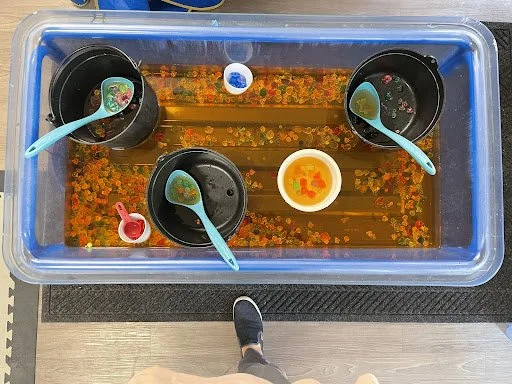
This week, the water table has gems with cauldrons and ladles. As they play a variety of fantasy games, kids are discussing attributes and sorting gems into sets. We have heard many exclamations about which gems children are collecting. As they announce that they want all of the white ones, because they’re bubble gum, or the ones with the hole in the middle, they are describing attributes and creating sets. The ability to recognize attributes underlies the ability to create sets, which are the basis of our number system.

In the water table, teachers have been encouraging math talk by asking clarifying questions and modeling language. When a child says “I want all of these,” teachers might ask which ones they mean. As children describe the item they want, we ask further questions to help clarify their thinking, and in some cases, we model descriptive language. In addition, we might ask questions that encourage children to consider more than one attribute at a time or to combine or take apart sets to create new ones.

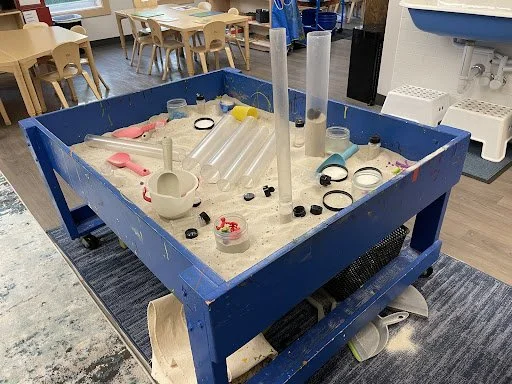
In the sand table this week, we have several long tubes of different lengths and diameters, empty spice jars, larger jars with lids and some people figures. Children have used these materials in a variety of ways, many of which inspire math talk. They have explored ideas related to volume, measurement and geometry. One key idea in measurement is knowing exactly which attribute you are measuring. Below is an example of a child working out how to describe which attribute of a cylinder he is measuring.

Child holds up a tube with a spice jar stuck on the end, with a big grin on his face. He exclaims, “look what I did! This fits! I want to do another one.” He then picks up a second tube and attempts to insert it into another spice jar. The tube’s circumference is much smaller than the jar’s and they will not stay together. “These don’t fit,” he notices, “I need a small one.” Another child hands him a different tube, which is again too big. He frowns as they come apart, stating, “No, I need a small one.”

“Small in which way,” we ask.

The child pauses and then answers “Um, the circle way. The circle part needs to be smaller.”

This led to multiple children offering tubes and everyone comparing the sizes of each cylinder’s “circle part.” 

It is in these small moments, through play and conversation, that we witness growth in children’s mathematical thinking. They occur throughout the day, in a variety of settings, and we’re so thrilled to share them with children! 

Some Songs + Dough, Again?

We've already compiled quite the list of group time songs, and we sing them on repeat. You see, young children thrive on repetition, need repetition. Repeated encounters with songs (also, materials, activities, people..) provides not only a sense of comfort, but opportunities for new discoveries, for mastery of skills, and for deepening understanding. 

A former teacher and dear friend recorded some of our songs. Here are a few we've been singing lately:

Little Fish

Bumble Bee

Time to Put the Baby to Bed

Three Orange Pumpkins

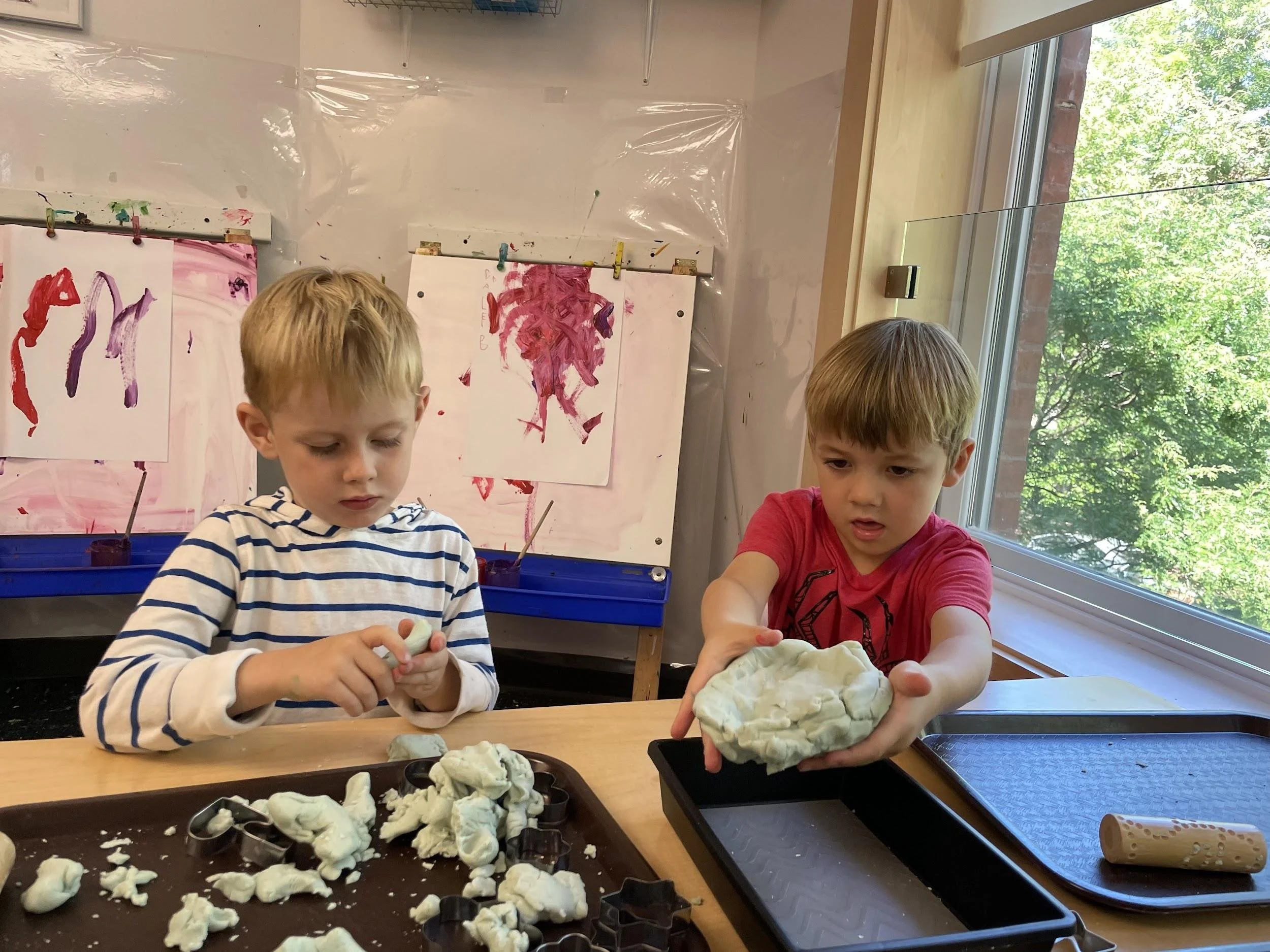
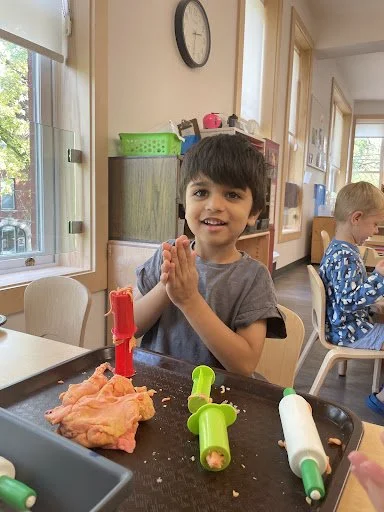
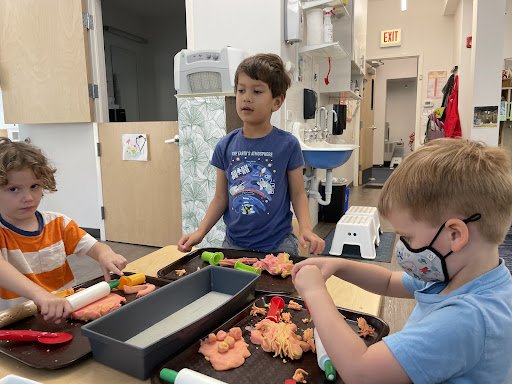
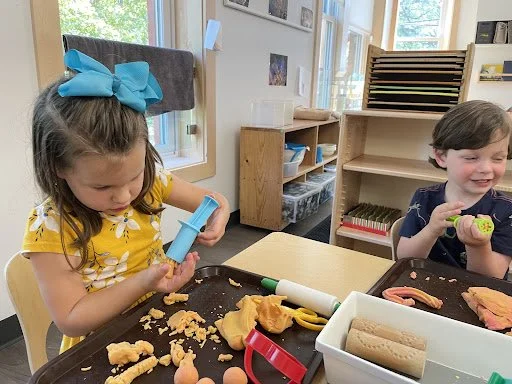
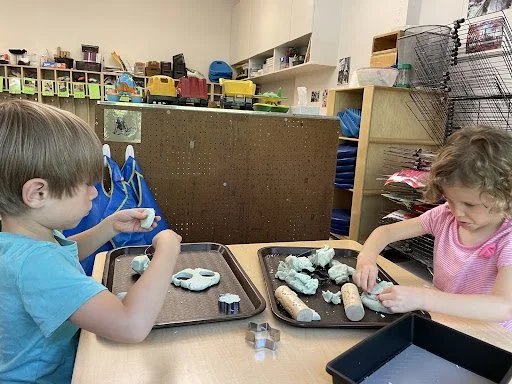
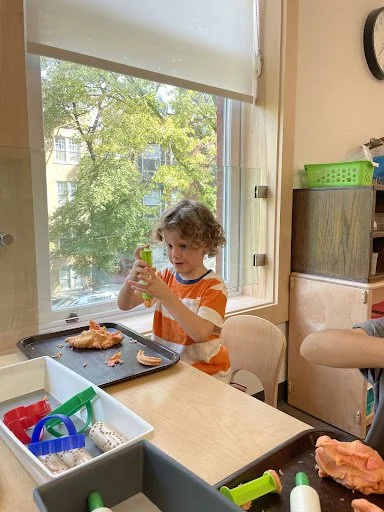
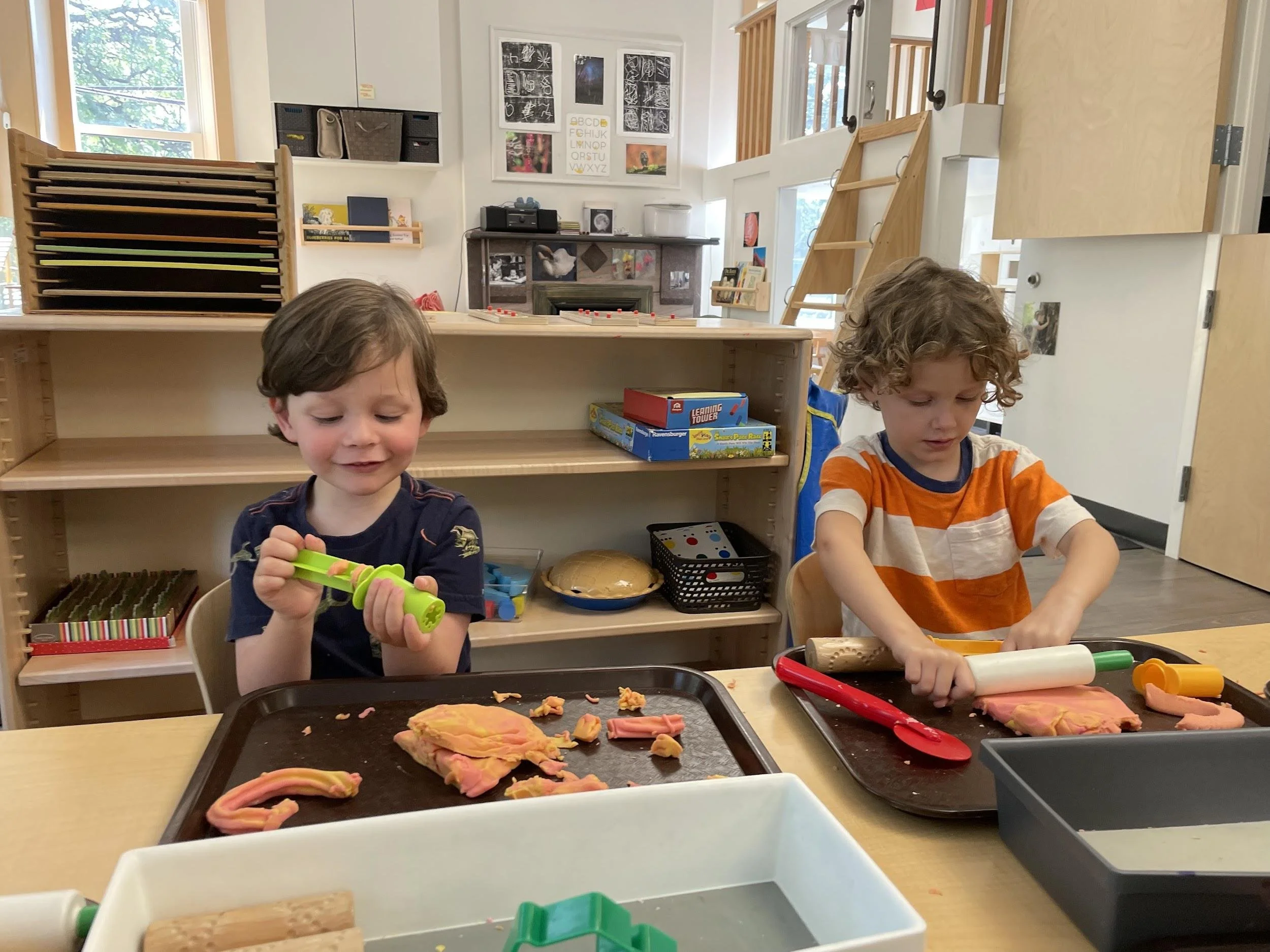
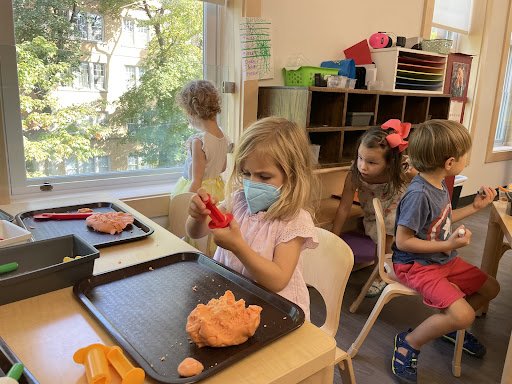
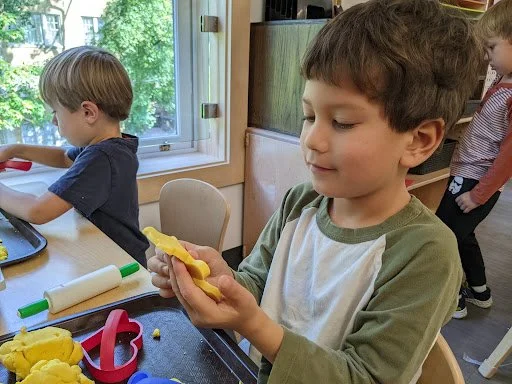
Play dough has been available to children since we started school. This will not always be, but we have found that it is incredibly helpful for children to have familiar materials during these first few weeks of school. They revel in the satisfaction of knowing what to do when so many things about school are new and challenging. We have provided novelty each week with new additions: different rollers, cutters with or without handles, a second dough color, dough extruders, people and animal figures; each providing new opportunities for exploration and discovery. Children have been likely to connect with each other at the dough table. They are stationary for a time, they can see each other, their space is clearly defined, they are asking for a turn with materials, they are showing off their creations and discoveries, and a few children are so inspired they have been singing a dough-duet each time they are at the table together!


WORK AND PLAY AND TABLE TIME

The concepts of work and play are dichotomized in our society.  We are taught that if we are doing one, then we are probably not doing the other.  However, we do not believe this to be the case, especially in the way young children learn.  Play is the medium through which children learn.  Our goal is not to transmit information from adult to child, but instead provide an environment where children can be immersed in explorations and construct knowledge based on their experience.  Teachers are there to provoke this process: to ask questions, make observations, provide assistance, create stumbling blocks, refer a child to a peer, help in the process of reflection…and so on, and so forth.

We seek to utilize the natural curiosity and wonder of children.  We want our students to have opportunities to explore what is meaningful to them.  We use what children are interested in as a tool to access and help form critical thinking and problem solving skills.  To meet children’s interests, we are very intentional in our creation of the classroom environment.  We create a space that invites exploration and stimulation.

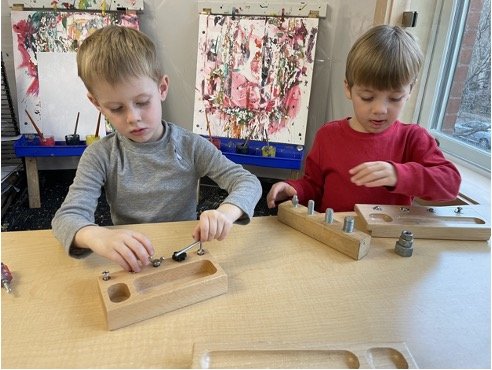
We are also intentional in creating a classroom schedule to meet children’s needs and to provide opportunities to connect. In JK, we include something called Table Time because we think it is useful to give children a developmentally appropriate dose of something they might experience in the future, say in Kindergarten. It is important to us to help kids begin to build tolerance for activities not of their own choosing, and to try something new, because we know there will be a lot more imposition on them at their future school experience. So, this is a time of day when we limit children’s options to activities at tables, but for a short period of time. We have so far allowed for a lot of free choice: a table to make art with materials self-chosen from the art supply shelf; a table with several puzzles and/or board games to choose from; and a table with small blocks and/or manipulatives to work with and do some small-format fantasy play. Even so, this time of day has consistently been too long for kids and feels nothing like the beautifully dynamic interplay of work and play we value. Those who arrive right at 12:45 might be doing table time for 15-20 minutes. It’s not the short, flexible introduction that we think is developmentally appropriate for kids, so we’re changing it!

Beginning next week (Sept 26), we will be moving Table Time to the end of the day. It will be easier to control the length of the experience, and it will allow us to create some meaningful and interesting activities for children to explore. We might give a prompt directly linked to the book we read at storytime, demonstrate new and interesting activities inspired by something children played at playtime, or give children a say by asking what they’d like to do and/or offering up a vote about a couple options. These prompts can happen right before children move to tables, which will be much more clear to children. 

Your child should have received a new picture schedule at school yesterday. If you haven’t seen it yet, ask them about it. Go through the pictures together and discuss the change with them. We introduced the idea at group time on Thursday, but many will forget over the weekend. If you think of it, talk about it again on the way to school Monday. Remind them that they’ll have a little more to choose from after washing their hands, and that we’ll try out a very short table time at the end of the day instead.

Community

As we embark on this new year, the question of “What is school?” looms large. We teachers believe that school is foremost a community. But what makes a community?  Is it a concrete structure? Is it a mindset? The dictionary defines community as “a feeling of fellowship with others, as a result of sharing common attitudes, interests, and goals.” These past few years in particular, our communities have been ripped apart due to the global pandemic. Our world communities, our national communities, our cities, our neighborhoods, our schools, our friends, and families. And yet thankfully, life moves on.

  In looking at the dictionary definition of community, it’s interesting to see how the idea is explained that one must share attitudes, interests, and goals. While we assume we, parents and teachers, probably all share some similar goals, children obviously don’t walk into the classroom with shared specific goals in mind. Or maybe they do!  Surely children do not necessarily all share the exact same common interests or attitudes! In fact, we teachers from day one in the classroom work diligently to help children understand that we all can have different ideas, different likes and dislikes, different “attitudes” about so many things. And that this is OK! In fact, it’s beautiful. Children are often bewildered by the concept that not everyone loves chocolate ice cream the best, or that dinosaurs are not everyone's favorite, or that someone doesn’t even like the color pink. Children this age are egocentric. No offense. It’s just the way it is. It is the stage of development that they naturally are in, and that they will be in for a while. One of our jobs as preschool teachers is to help children begin to “de-center,” take a look around, notice that others are nearby, and that they sometimes have similar ideas but sometimes they have different ideas. In school, it is our hope to share a common desire to care and to be a part of something. This is what we feel it means to be a part of a community. This is what it means to be part of a community at Park West. So welcome, we are so glad you’re here.

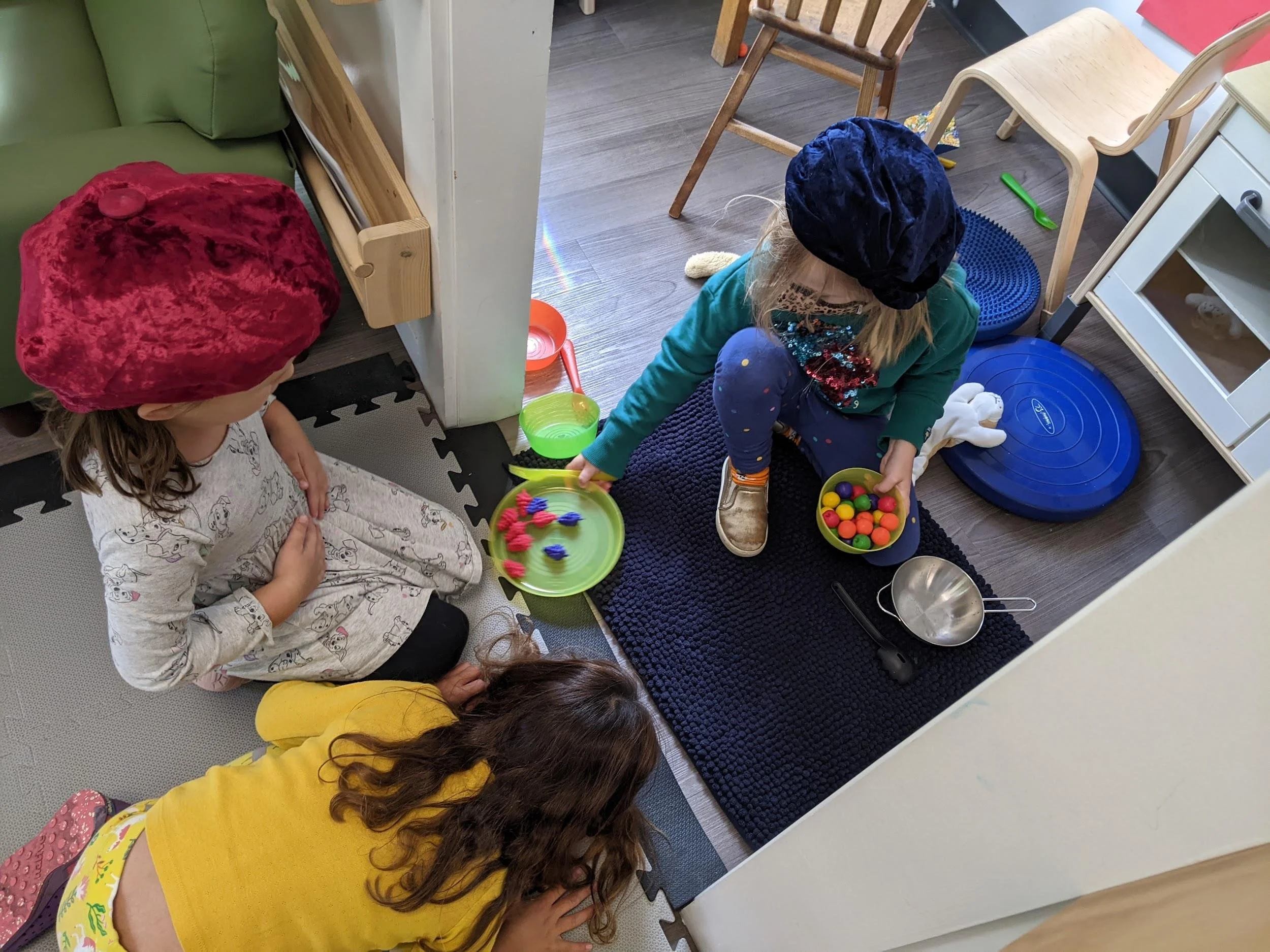
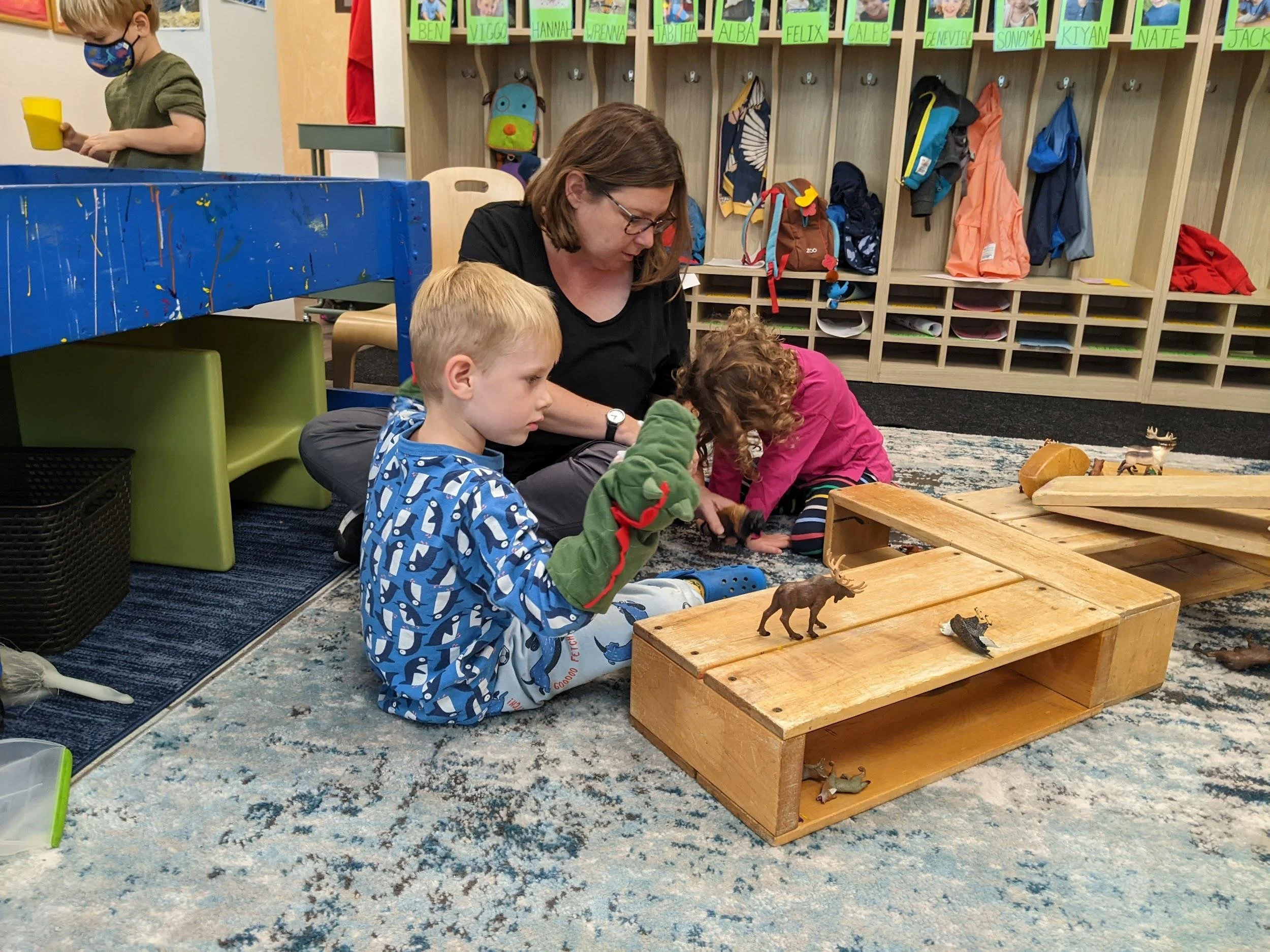
Here’s a little look at what kids were up to during play time one day…we may not always include photos, or photos of everyone, but it worked this time!