
Young children develop their understanding of math concepts through direct experience. At school, we provide a variety of materials and activities to provoke mathematical thinking. In addition, we encourage talk about mathematical concepts as they relate to children’s play. Research shows that talking about math helps children to refine their thinking and develop a deeper understanding of it. The sand and water tables provide natural opportunities to explore mathematical concepts in ways that are both engaging and meaningful.
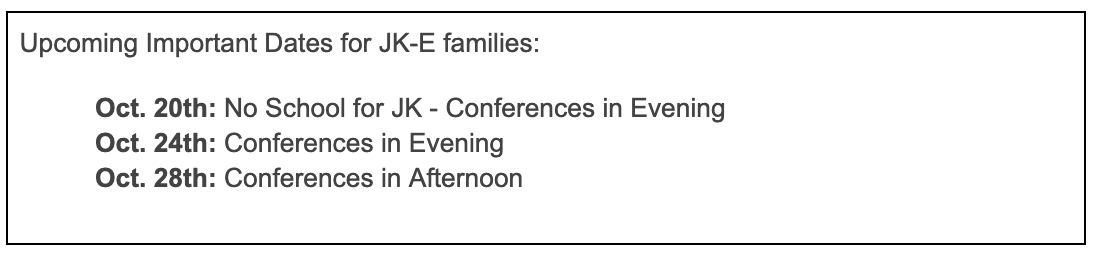
This week, the water table has gems with cauldrons and ladles. As they play a variety of fantasy games, kids are discussing attributes and sorting gems into sets. We have heard many exclamations about which gems children are collecting. As they announce that they want all of the white ones, because they’re bubble gum, or the ones with the hole in the middle, they are describing attributes and creating sets. The ability to recognize attributes underlies the ability to create sets, which are the basis of our number system.
In the water table, teachers have been encouraging math talk by asking clarifying questions and modeling language. When a child says “I want all of these,” teachers might ask which ones they mean. As children describe the item they want, we ask further questions to help clarify their thinking, and in some cases, we model descriptive language. In addition, we might ask questions that encourage children to consider more than one attribute at a time or to combine or take apart sets to create new ones.
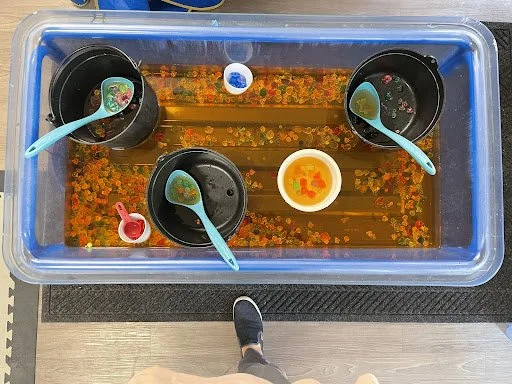
In the sand table this week, we have several long tubes of different lengths and diameters, empty spice jars, larger jars with lids and some people figures. Children have used these materials in a variety of ways, many of which inspire math talk. They have explored ideas related to volume, measurement and geometry. One key idea in measurement is knowing exactly which attribute you are measuring. Below is an example of a child working out how to describe which attribute of a cylinder he is measuring.
Child holds up a tube with a spice jar stuck on the end, with a big grin on his face. He exclaims, “look what I did! This fits! I want to do another one.” He then picks up a second tube and attempts to insert it into another spice jar. The tube’s circumference is much smaller than the jar’s and they will not stay together. “These don’t fit,” he notices, “I need a small one.” Another child hands him a different tube, which is again too big. He frowns as they come apart, stating, “No, I need a small one.”
“Small in which way,” we ask.
The child pauses and then answers “Um, the circle way. The circle part needs to be smaller.”
This led to multiple children offering tubes and everyone comparing the sizes of each cylinder’s “circle part.”
It is in these small moments, through play and conversation, that we witness growth in children’s mathematical thinking. They occur throughout the day, in a variety of settings, and we’re so thrilled to share them with children!