What a week it’s been! Amanda and Katrina are thrilled to be back in the classroom after both being out sick. Kids have been busy with classroom activities and we returned to a lot of thinking and talk about math. Discussions about number and operations are common in JK as kids encounter mathematics in everyday situations. Since children are naturally invested in questions that relate to their play and classroom life, supporting and extending math talk is a powerful tool for helping children develop their understanding of mathematical concepts. In addition, these conversations provide teachers with insight into each child’s approaches to learning and understanding of math topics. Here are a few examples from just one day at school:
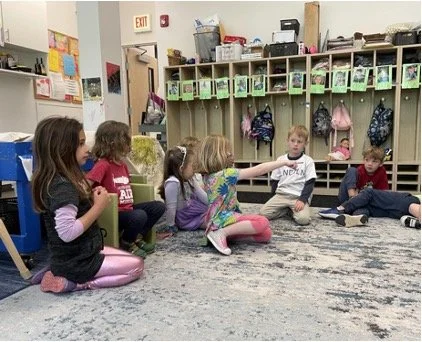
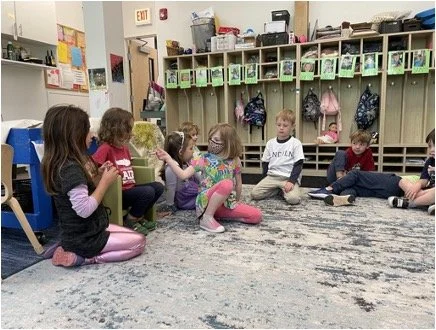
We had 3 kids out on Wednesday which led to a question - how many were at school if 3 were missing? How could we find out? Some kids had reasonable guesses, but how could we know for sure? When we talk about who is missing, kids typically reference the cubby tags, which are visible from the group time rug. One child automatically thought to reference that again, but each tag has both a name and a number. Did the number assigned to the last tag we looked at denote the number of children who were at school? Children agreed that it did not. Someone else decided to count the cubby tags of kids who were present, but that also proved tricky and yielded different results. Finally, someone else suggested counting the actual kids who were sitting on the rug. This led to several rounds of counting to make sure all were accounted for, including the child doing the counting.
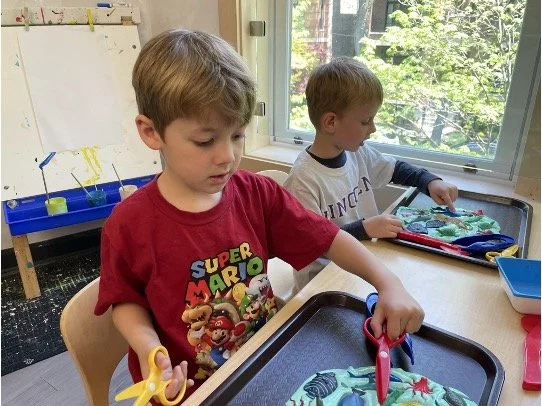
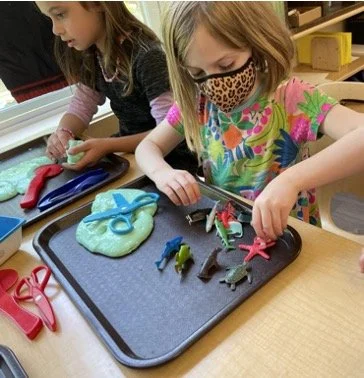
This week, we added sea creatures to the putty kids have already explored at school. Everyone liked the creatures and some kids said that they needed more because others had more than they did. Teachers asked how they knew who had the most. They said they could tell by looking (estimation - a critical skill for making sense of mathematical problems!) Then the question posed was how could you check? Each child took a turn counting their creatures, some with teacher support as the numbers got larger or because it was hard to remember which creatures had been counted and which hadn’t. It turned out that one had 24, one had 17 and one had 12. Their estimations of most and least were correct! But how to remedy the situation? With math, of course! To start, teachers recorded each child’s total number of creatures. The child with the most creatures started out by offering the one with the least 2 more. Then we had more math to do. Some attempted to count down from 24, but then were unsure and changed their ideas afterward. So, we checked by counting. Then, the child with 12 had to think about how their number changed and we again checked with counting. Was that fair? Some thought so, but others did not. They did agree that it wasn’t equal. Then another child joined the play who had zero creatures, so more negotiating and counting ensued. Issues of fair share at school present opportunities for children to compare quantities and act out mathematical operations. In this case, the operations were addition and subtraction, but it could also be approached as division. At times, children have different ideas about how to approach problems which leads to rich and lively discussion.
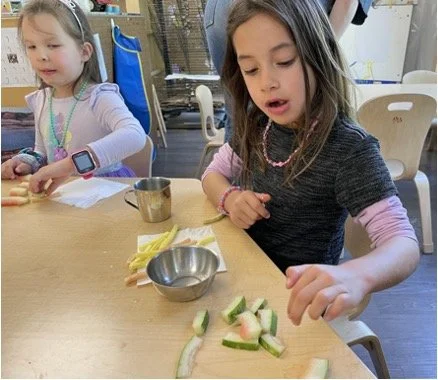
At snack time, kids were excited about the watermelon that was served. It was cut in small wedges, and it felt satisfying for kids to help themselves to a lot of pieces. Many gathered a large number of rinds as they ate and counted them. They compared their quantities to each other’s - who had more? Who had less? Who was full? Who wanted more? One child said she needed one more to reach “the world record of ten.” Then, others started to think about how many more they would need to reach ten. Everyone had ideas to share about this. Some kids were pretty sure about their numbers, but others were less sure. They talked about it with each other, sharing their strategies for how they came up with their answers and trying them out.
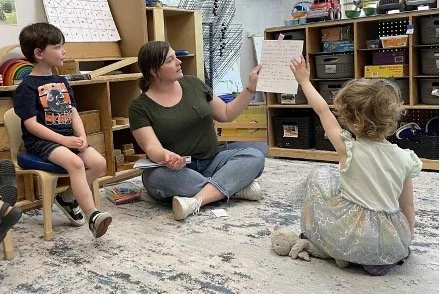
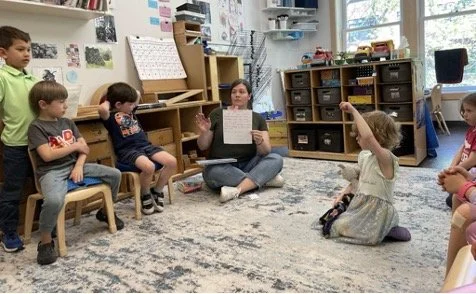
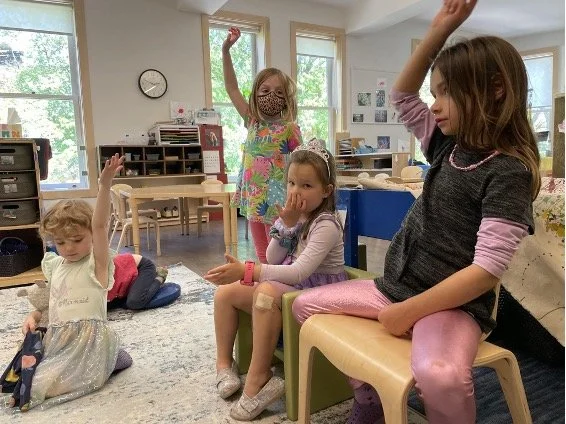
At group time, we had a note to read from the morning class. They had seen some numbers that one of the JK kids had hung up around the room and wondered about them. What were they for? Who made them? As we discussed what to write back about them, the creator (Sammy) told us that they were about what you do when you first enter the classroom: First, you put your stuff away. Second, you wash your hands. Third, short play. These are ordinal numbers and we welcome their use and discussing them. As you can see from the many raised hands, children were highly engaged as we discussed both the numbers that Sammy hung up in our room, the order of procedures for entering our classroom, and composing a response to the morning class.