
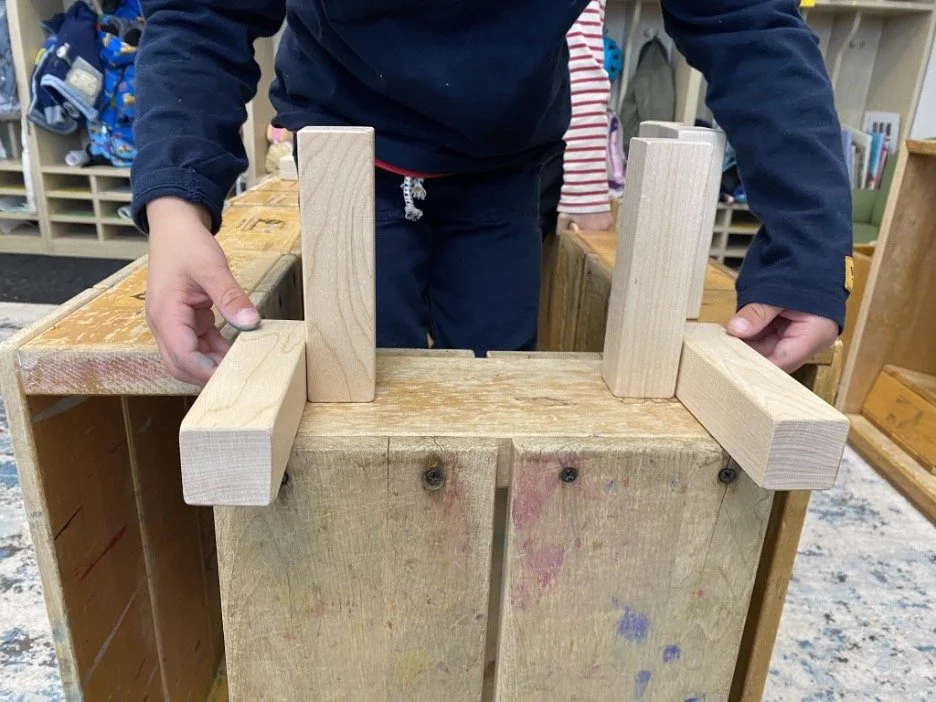
Teachers have noticed over the past month or so that gun play is making its way into fantasy play with certain groups of children in our class. Gun play is a type of “power play” that we often see working its way through our classroom at some point during the year. Superhero play and “bad guy” and “good guy” play are also included in the realm of power play, which can involve pretend violence. Last week we decided to have a discussion during group time about guns. Specifically, about gun play at school.Teachers wanted to bring this topic up at group time so that everyone in our class would be able to have a voice about how they feel, as well as to hear what the parameters are around this type of play. As adults, and teachers, we have strong feelings about real guns, weapons, and violence. And in spite of those strong feelings, we do allow gun play at school. However, there is a strict caveat. Children who want to pretend they have a gun, whether that be pointing their finger or one made from a block or other various objects, must get consent before they point and shoot at another individual. Teachers have been talking to the individual children in our class who are gravitating towards this type of play and letting them know about our rule in regards to consent. We felt it was important to open up the dialog to everyone, so that we all understood that consent was needed before “shooting” could ensue.
So, if we don’t condone actual violence and we wish to see a world with less guns and shootings, why do we allow this type of play in our classroom? We all know that young children are drawn to these themes - good and evil, power and control, fantasy and reality, but is it really beneficial to allow them to explore these themes in our classroom? We think that giving kids the chance to use play to explore these ideas is important, and have found over the years that restricting the play does not make it go away, but rather forces it to happen in secret where adults can't provide commentary or reflection.
Children are actually meeting several developmental tasks through this type of play, according to “The War Play Dilemma,” a book by Diane Levin and Nancy Carlsson-Paige. Consider this passage from the book: "The potential exists for children to work on numerous developmental issues when they engage in play. One major task young children face is that of gaining control over their impulses (Kegan, 1982). In war play, children assume the roles of powerful fantasy characters, express aggression in pretend situations, and engage in ‘pretend fighting,’ all of which can help them to learn about impulse control as they struggle to stay within acceptable boundaries and receive feedback about their actions from the environment.”
While we feel this sort of play can meet the developmental needs of children, we still have the job of making sure the classroom is both physically and emotionally safe, and that the children involved in this sort of play do not impinge on the rights and needs of others in the group. We have an important role and responsibility when allowing this type of play. For example, we set boundaries around physical play such as wrestling, by noticing and redirecting when it's happening in an unsafe environment, and if those who don't want to participate are being unwillingly included in the game.
At school, teachers feel strongly about the necessity of listening closely to what children are playing, and not placing adult understanding and constraints onto children’s play-schemes, as they are qualitatively different experiences. We feel that children playing out themes of death and destruction, power and vulnerability, good and evil are part of healthy development, even if they make us as adults uncomfortable. Our goal as teachers is not (nor should it necessarily be) to steer kids' play away from themes of good guy/ bad guy “violent” play. And that just because a person’s three, four or five year old understanding of good and bad may be very black and white, that doesn’t mean that same understanding will carry over into adulthood. And so we let them play….