
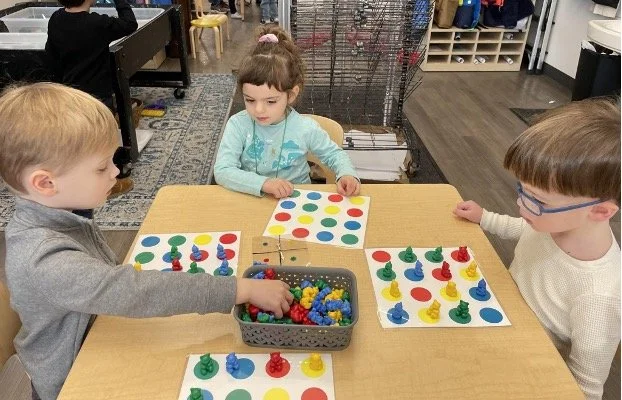
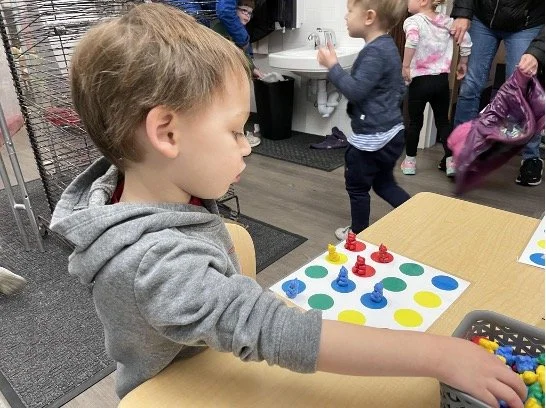
The second half of the school year is when we begin to introduce games with rules to children in the 3-Day class. The first game we typically introduce is teddy bear bingo. First, we offer just a selection of colored bears with a board covered with dots of corresponding colors. Children are charmed by the bears and enjoy matching the bears to dots of the same color. Placing one bear on one circle helps children to develop one-to-one correspondence, a precursor skill that is required for counting. After children have some experience with the bears, we add a spinner. Children are then encouraged to use the spinner to determine which color bear they will place on their boards. Since there is only one spinner and four boards, children must take turns to use the spinner and this inspires a lot of conversation and negotiation. For some, it takes some time to accept the notion that they will not choose the color of each bear they take. Many decide to point the spinner deliberately at whichever color they’d like to take when it’s their turn.
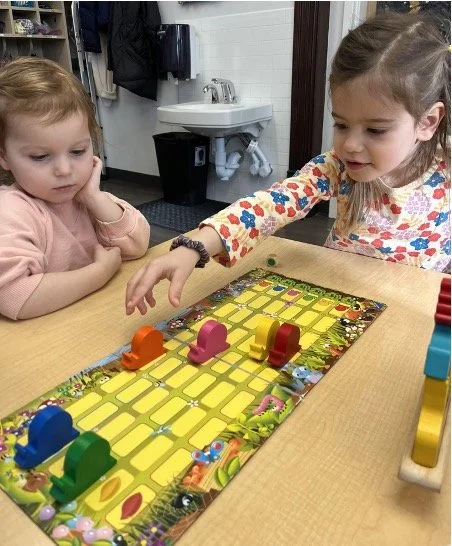
After introducing teddy bear bingo, we offered children a simple game called snail’s pace race. This game has a board with colored squares, snails with colors that coordinate with those squares and a die with a color on each side. To play the game, each of the snails is placed on the square of the same color on one side of the board. Then, each player takes a turn to roll the die. The die will show one color on the top and that color snail gets to move forward one space.
This game seems pretty simple, but for children this age, it takes a great deal of self-control to wait for a turn, resist moving your favorite color snail and then move the snail whose color was rolled just one space.
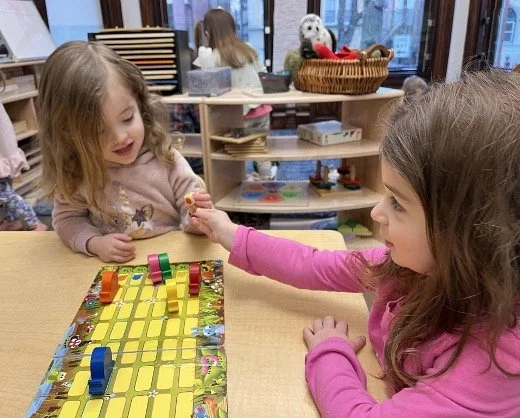
Many children are inclined to choose one color of snail to always move, but that isn’t how snail's pace race works. In this game, we aren’t racing against each other, rather we are helping all of the snails to take turns racing to the end of the board.
Aside from providing practice with self-control and turn-taking, this game reinforces those same early math concepts as teddy bear bingo. Matching colors is one skill that is required to play the game. Children must also use one-to-one correspondence as they move each snail one space each time they roll. This seemingly simple skill is often tricky for young children. Playing this game gives children the requisite experience to develop this precursor skill necessary for counting with meaning.
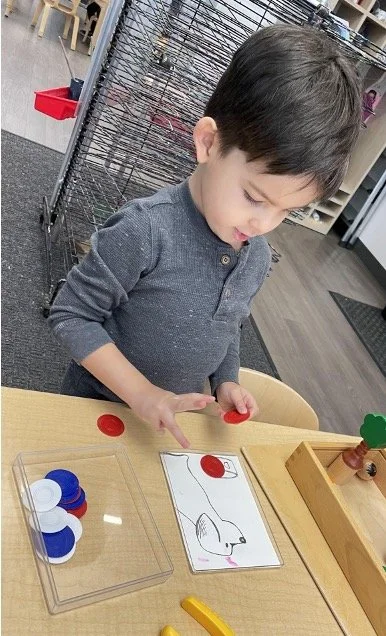
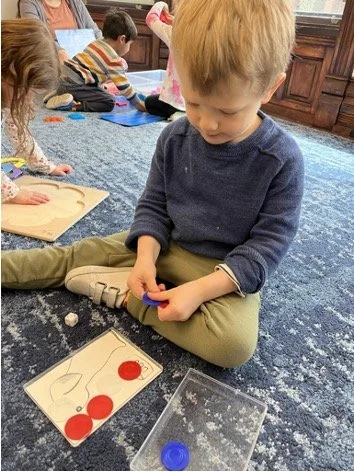
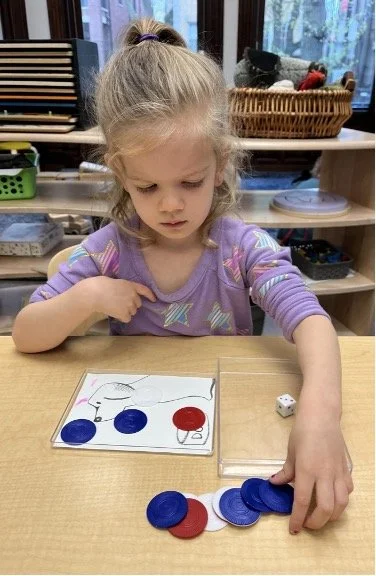
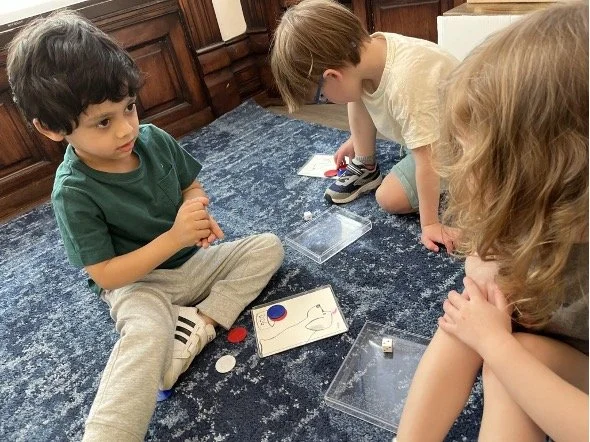
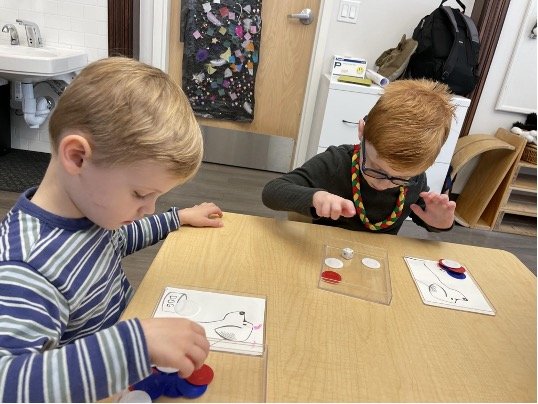
After children had some experience with both of these simple games, we introduced feed my dog, which requires counting. In this game, children roll a die with either 1, 2 or 3 dots on each side. They then take that number of plastic chips and place them in the dog bowl on the game board. We limit the quantities to just 1, 2 and 3 because we know that children need a lot of experience with these smaller quantities in order to have a deep understanding of them. Number knowledge builds, so having a firm grasp of small quantities helps children to eventually comprehend larger numbers. Children have been enjoying feed my dog and can choose whether they’d like to play it solo or with a partner.
We are sad to let you know that Dhruv will no longer be attending Park West. We will miss him and his family and are grateful for the time we got to share with him in the classroom this year. Last week we let kids in 3-Day know that Dhruv has gone to a new school. We told them they could make a picture for him if they wanted to. Some kids did, and we passed those on to Dhruv and his family. We will no doubt continue to remember Dhruv, especially when we gather on the rug after playtime and notice if any kids didn’t come to school that day. We wish the best for Dhruv, Garima, Yash and Samar.