
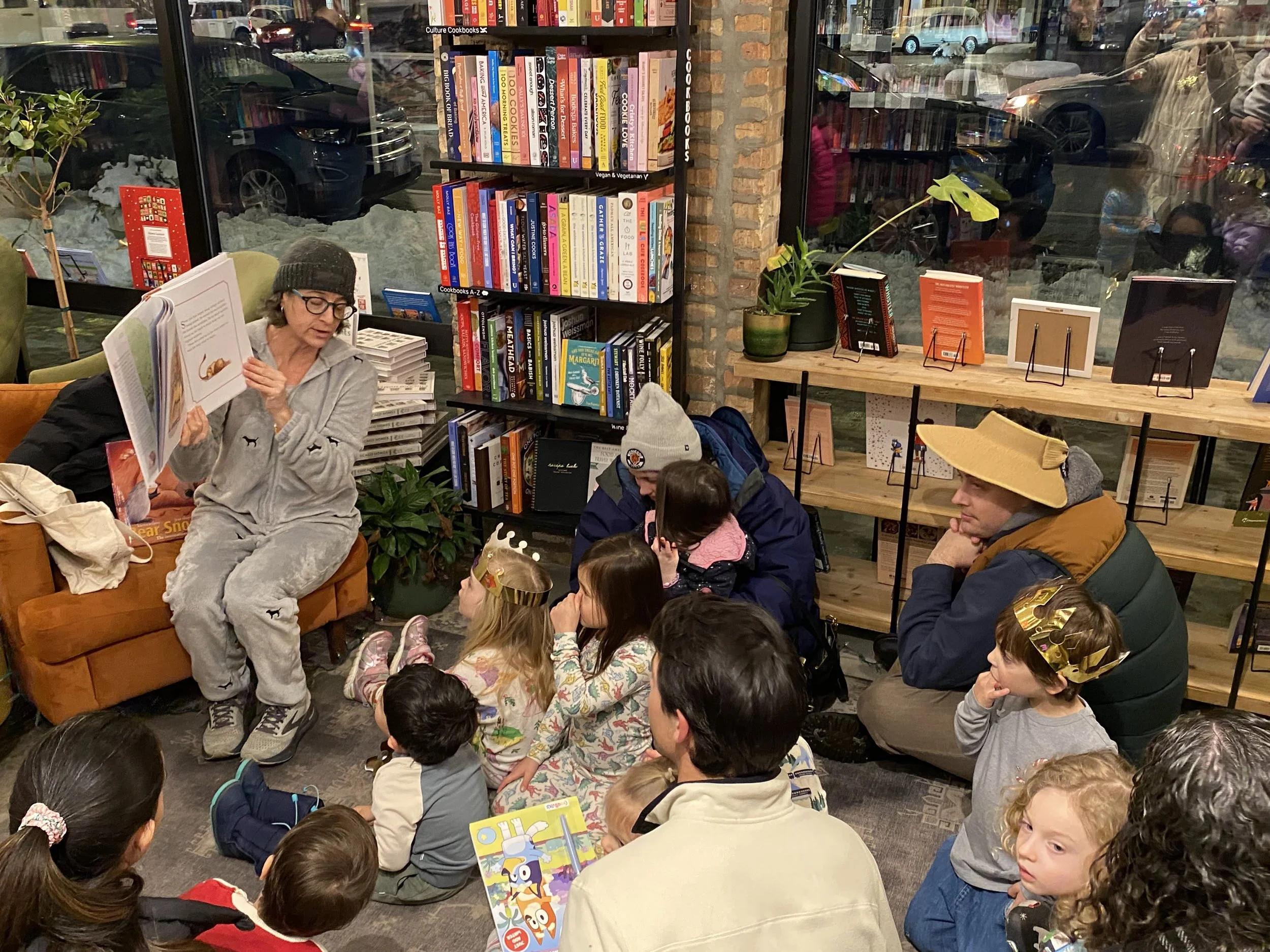
Reading stories is an important component of our school day here at Park West, as it often is in homes. But what exactly do children get out of story time at school? Read-alouds present many opportunities for learning, but a primary goal is for children to develop their comprehension skills. Building comprehension skills in preschool is essential for fostering a love for reading and developing critical thinking abilities. This remains a goal throughout a child’s trajectory at Park West, but we support that in different ways, depending on age and developmental levels.
For our youngest students we start this journey by choosing short stories that children can relate to personally. We know that the attention span of a 2.5 year old is brief, and that children are often used to hearing stories one-on-one, sitting in a caregiver’s lap with the book right in front of them. Attending to a book that’s being held at a distance, and resisting the urge to run up to touch the book or interrupting to share an idea, can be challenging for kids this age, so we try to keep stories shorter, with simple language and choose stories about everyday life, which children can easily relate to. A long time favorite in the fall is How Do I Put It On? in which a bear dresses himself, making mistakes along the way. This is a challenge many of our youngest kids are working on. Being able to help Bear figure out where the clothes go is engaging and inspires feelings of confidence. Bear isn’t quite sure about where the clothes go, but the kids are. Many kids will, after giving Bear some advice, chime in about their own adventures getting dressed. My mom helps me with my socks! I can’t do buttons yet. I can open the velcro on my shoes. Kids are relating the story to their own experiences, which is a key step in building comprehension skills. As the school year continues, the stories lengthen, and teachers ask questions that prompt children to relate the story to their own lives, predict what will happen next and infer how characters might be feeling.
As kids grow through our program, we offer increasingly longer stories with more complex language as kids show readiness for them. We often choose books related to topics kids express interest in. If someone reports that they are giving up their crib and getting a big kid bed, we have books about that. Many read-alouds deal with trying something new, coping with strong emotions, making friends or sibling relations. Or we might offer stories that relate to a current play theme or topic of interest. Stories offer another way to delve deeper and engage in thinking about topics that are relevant to children.
A class might read multiple versions of the same story, helping children internalize the characters, plot, and key events, while also identifying the similarities and differences in each version. Opportunities to act out stories, either with toys or by staging a play also contribute to a child’s comprehension.
Our JK class is currently engaged in an extended study of The Three Billy Goats Gruff. The exploration began with readings of multiple versions of the story. Children reflected on similarities and differences, recognizing that, while the basic story structure and events were the same, the depictions of the troll were different in each book. Teachers provided some small toys for children to use to act out the story during playtime. Kids used these items to create the setting in the story and acted out each goat crossing the bridge and the troll confronting them. Each child brought their own interpretation of the story to the activity, some even altering their voices as they acted out each role. Role-playing characters from a story allows children to immerse themselves in it and better understand the perspectives and actions of the characters.
The class is now engaged in staging a production of the Three Billy Goats Gruff. Children sign up for roles as actors or the set crew. As they recreate the story, children must create and retain mental images of each character and their actions in order to reenact it. The set crew must also maintain these images as they create the physical setting, laying out blue fabric for water, green fabric for the meadow, arranging flowers in the meadow and building a bridge that not only crosses the water, but is also sturdy enough to hold a child. In addition, the set crew provides visual cues for each actor, showing them where they will stand or sit on stage as the play unfolds.
The ability to create mental images supports comprehension as kids explore increasingly complex stories. Using mental imagery activates multiple parts of the brain, including language processing, memory, spatial reasoning and emotional response. Research shows that using imagery-based strategies while reading improves engagement, recall and summary ability.
Later in the year, teachers will introduce chapter books, which have more words and very few pictures, calling on children to create mental images instead of relying on illustrations. These earlier experiences acting out stories aids in the ability to create mental images, which will greatly aid children as they engage with the written word long after they’ve left Junior Kindergarten.
These early experiences with stories in the classroom do so much for children. Not only do they build literacy skills, but they generate excitement and help children make sense of the world around them, setting the stage for lifelong learning and a love of reading and books.
I hope you enjoy sharing books at home with your child as much as we enjoy sharing them in the classroom.
-Katrina
Katrina Nousaine Mann, Park West Co-Op Preschool Education Director, wrote this post.
You can schedule a visit with Park West Co-Op to learn how your child can enjoy a joyful learning environment while being nurtured to discover, connect and be curious about the world around them.
Park West Co-Op is a play-based preschool located on Chicago’s near Northside in the heart of Lincoln Park. Park West is a diverse group of teachers who are experts in early childhood education. We've dedicated ourselves to understanding and developing teaching methods that cater to each child's individual needs so they can grow in a positive way. Teachers work hand in hand with the parent run Co-Op and offer robust hands on parent education in the classroom.