
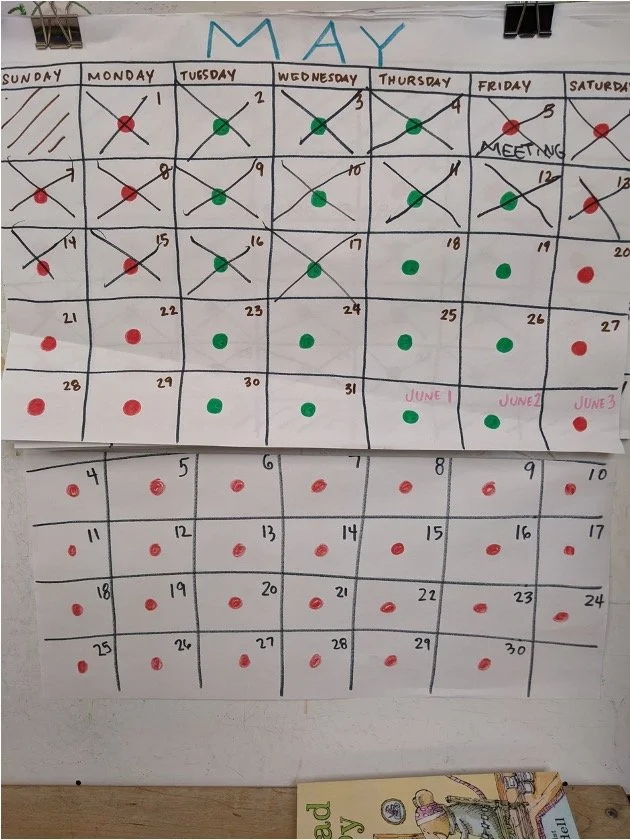
We began talking about the end of the school year this week. With this being our final full calendar page, it was unavoidable. We counted the remaining green dots on our calendar page, and we showed all the red dots in June. We asked if kids know what those red dot days are called, and we told them it’s “Summer Break,” which is when everyone has lots of family time.
We touched on camp when someone brought that up, and we explained that not everyone will do camp. There will be some new kids, some new teachers. Camp is not the same as school. The last green dot on our calendar page really is the last day for these kids and these teachers to be together in this room for morning class.
This was likely the first of many conversations we will have with kids about the end of this school year and what will come next for each of us. We will provide opportunities for children to share what they know about what comes next for them, but we won’t provide information about new schools or new activities unless they open that door. We will help kids work through their feelings about this by reflecting on other times they’ve experienced change (the start of this school year, for example), and by helping to develop strategies for staying connected (play dates, for example). Most of the time, kids relax when we reassure them that their own grownups know what their plan is, and that school doesn’t start again until after lots and lots of red dots with their family. As much as one school year or one summer feels like it goes by at lightning speed for us adults, it really is a very long time for young children. It can be too much time to worry about something new, so we recommend you try to focus on the present with kids as much as you can. Give accurate information, but really dig into the new school stuff closer to the end of the summer.
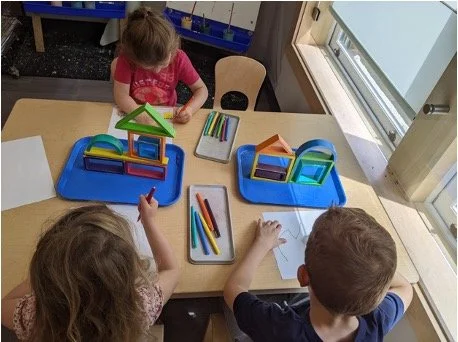
In the meantime, we are still chugging along here at school. This week we’re doing a representational art activity about drawing buildings. Teachers build something with hollow blocks in basic geometric shapes. These structures are placed in the middle of a table. There are felt tip pens in colors corresponding to the shapes. We ask children to try to draw the shapes as they are in the structure. To do so, they must take into consideration so many things in addition to being able to draw a square or a triangle. Orientation, size, space needed…plus, we expect drawing individual shapes to be difficult for kids this age. Children typically begin to draw shapes between 2 and 5 years old and there’s a pretty wide range of ability within these years.
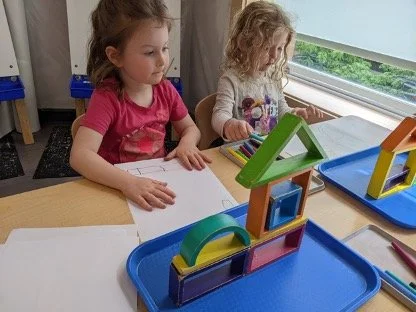
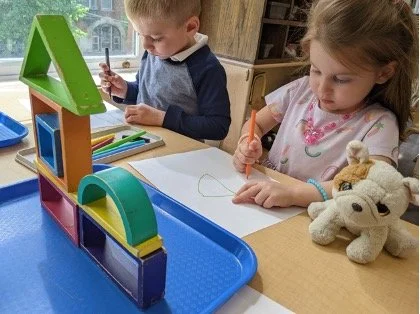
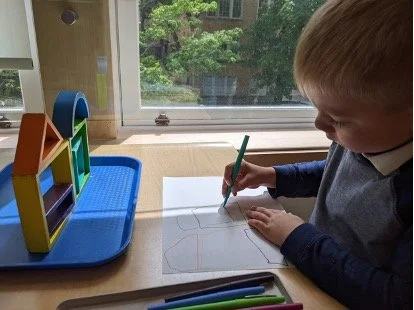
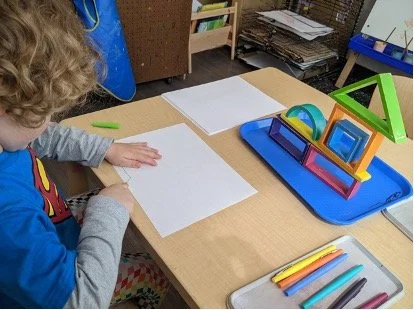
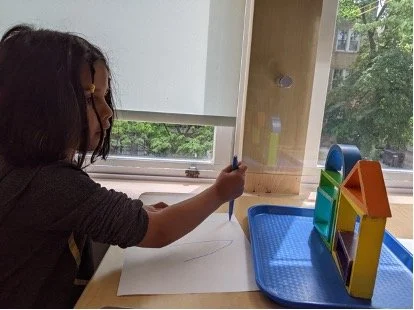
So, this activity is a stretch. It’s a stretch we wouldn’t have asked of kids earlier in the school year, even just a couple months ago. Children need to feel safe to take risks like this, their work needs to be accepted and embraced many times over. They need to know it’s not just okay, but good, to do it their own way, as one child told a teacher very clearly when he proudly held up his work to show her. “I did it my way!” he exclaimed, with a giant grin. We cannot force someone to be able to draw a triangle before many different factors line up for them. To support each child’s individual development of these skills, we may scaffold their work in a number of different ways: maybe by drawing dots for them to connect, or holding a marker hand-over-hand, or simply backing off to give someone the privacy they need to try it their way without an audience the first time. As with so many things, there’s no one way to go about it.