Face Page

At the end of the day on Tuesday we showed kids the face page with photos of the kids and teachers in our 2AM class and another copy of the picture schedule on the back. They were excited to see it and, no doubt, eager to hear Katrina read their own name as she pointed to each photo and said the name of the person she was pointing to. Everyone got to bring home their own copy of the face page, and we expect kids' initial interest in the photos will be to find their own and perhaps exclaim, “That’s me!” That’s typical for this age group for they are most likely wondering where am I on this page, in this group, amid the rest of my peers? Children in preschool are primarily following their own interests – finding out what they like, what they are good at, what they find challenging.

We also expect that over time they will get to know the other members of the group and begin to find their place within the context of this group. Who else likes to paint? Who is really good at block-building or putting together puzzles? Who do I like to sit next to when it’s time for snack or the story? As teachers we encourage children to use one another as a resource. This can help raise children’s awareness of who their classmates are as well as foster connection among them. We might ask one child to show another where they found the paper or encourage children to tell or show how they worked out a problem with the magna tiles. We also sing name songs and have made a family picture book in our class to help further this process of knowing one another. It is an on-going process, to navigate the social scene at school. Children work hard to construct their knowledge about social relationships, and we take seriously our job of supporting them in their explorations. 

Aside from the work we’ll be doing in school to get to know one another, the face page can facilitate some good conversations for children at home with their families. It can be a resource for figuring out who your child is talking about, especially when their description stops at “the kid in the blue shirt....” It can even serve as a literacy tool when children begin to notice the names of their classmates and think about who has similar letters to theirs or who starts with the same letter of the alphabet.

The picture schedule is also a useful tool in talking with your child about school. It can be a nice prompt for kids to talk about activities in the different parts of our day and may help them remember more details of their day by reviewing the pictures in the schedule. The picture schedule can also continue to reinforce the routine of our days at school and support the mastery kids are developing of being at school. 

It was great to have kids back at school this week and wonderful to be back together again!

Eye Droppers

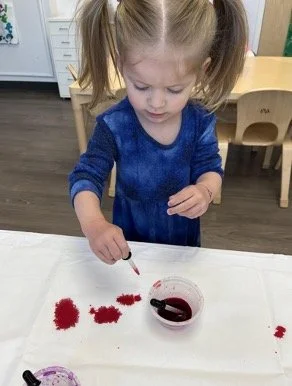
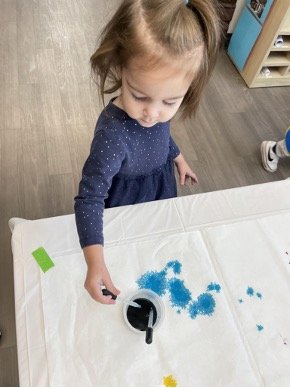
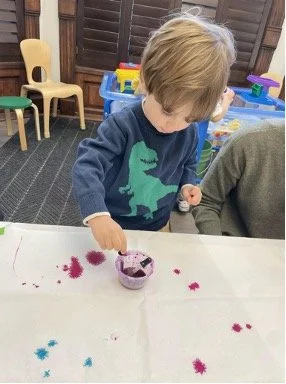
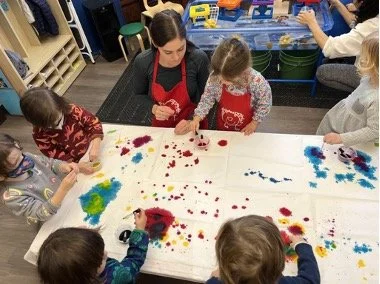
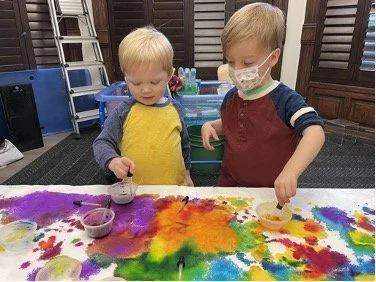
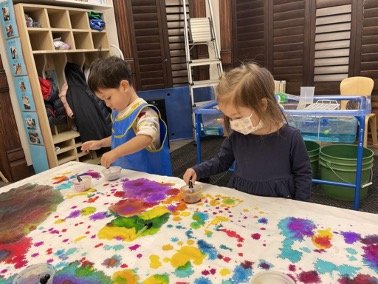
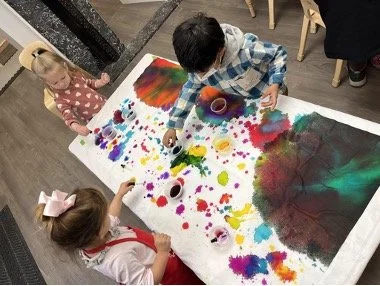
Last week we introduced the use of eye droppers with liquid watercolors during play time. Kids could experiment using the droppers with different water colors and dripping the colors onto a large piece of diffusing paper, a fabric-like paper that allows the watercolors to soak in.

This method of applying watercolors provides a different kind of challenge for kids, and one that was not familiar to most. It may seem simple to adults, but if you break down all the steps, using an eye dropper really is a lot to coordinate. You have to be able to grasp the tiny bulb at the end; dip the tip into the liquid; squeeze the bulb, and then release before lifting the tip out of the liquid. It takes some self-control, too, to avoid squeezing until you reach the paper, and then squirt out the color!

Teachers provided some coaching during play time, but it can take many attempts until children actually construct their understanding. Telling doesn’t really do it - one has to try and retry to get the hang of it. You can see the focus and concentration on the faces of some of the kids working with these materials. We also got to see the delight kids felt when they could fill the eyedropper up with a color and squeeze it onto the paper.

We like these activities that combine art with elements of physical knowledge. They appeal to kids’ sense of curiosity, to their fascination with figuring out how their actions affect objects, and they provide lots of practice with sequencing, fine motor coordination, and persistence. They also provide visual records of all the thinking kids have been doing, and plus, they’re pretty!

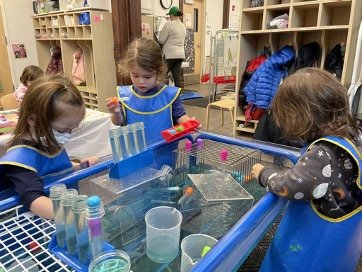
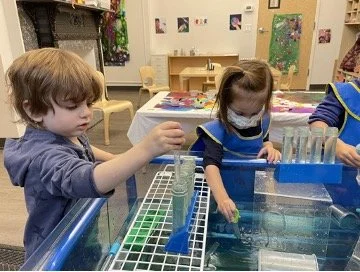
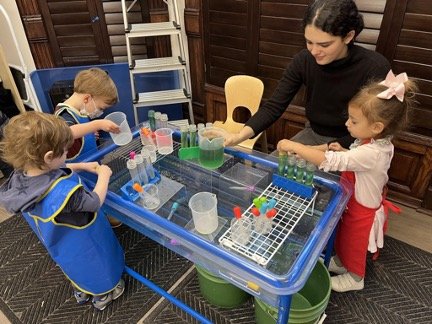
This week we introduced larger versions of droppers in the water table while still making available the small eye droppers with watercolors at the art table. This allows kids to have the chance to build on last week’s experience and continue their understanding of how these same but different kinds of eye droppers work with colorful liquids.

We look forward to more exploration when we return from Thanksgiving break!

Enjoy your time with family next week. We continue to be so grateful for our time with your children at school and for the support and community that you all have been providing this school year. Thank you!

Car Wash

On any given day in the classroom, you’ll find many children playing with vehicles. We offer lots of different opportunities for this type of play, and children approach it in a variety of ways. While some build roads and bridges for their cars to drive on, others enact a variety of fantasy games in which cars race, buses drive people around and dump trucks are repeatedly filled then dumped. Vehicle play offers many opportunities for growth as children explore a variety of physical properties, act out familiar scenarios and negotiate materials and ideas with other children.

So far this year, most of the vehicle play opportunities in the classroom have been on our block rug. We have been noticing that some children like vehicles so much that they are hesitant to move to other areas of the room. Others who are interested in vehicles might shy away from an area that is so busy and has undefined spaces. Because of this, we decided to move some cars to the water table.

This new set up has sparked interest in vehicles from children who had formerly not sought them out and encouraged those who spend most of their day on the block rug to investigate new areas of the classroom. Exploring a familiar item in a new way has been exciting to children and offered teachers new insights into their thinking.

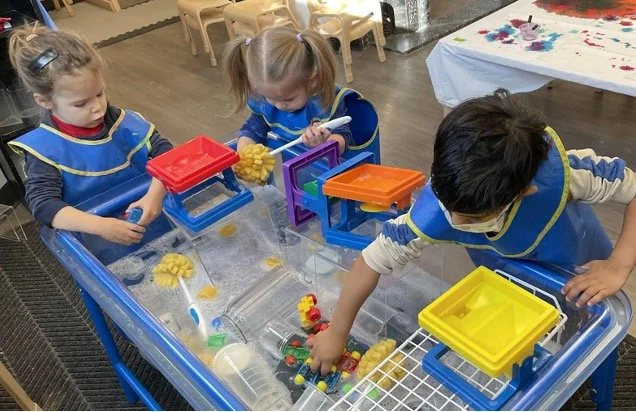
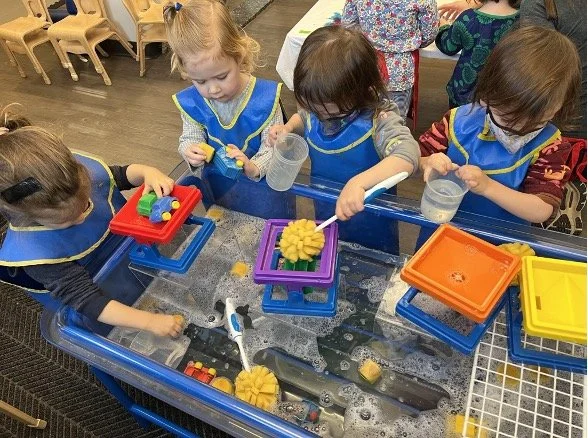
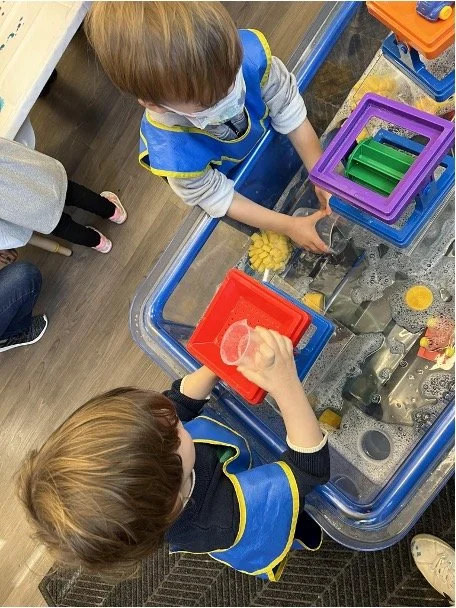
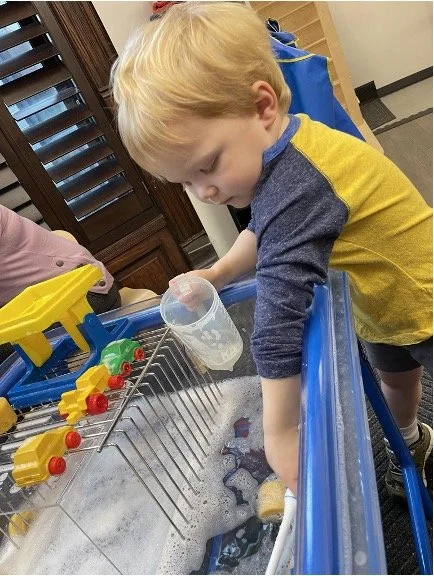
In the water table, we have set up a variety of vehicles with sponges, brushes, soapy water and water wheels and sieves. We modeled using the sponges and brushes to wash cars as well as pouring water over the wheels and sieves while cars are underneath, getting cleaned. Children have been excited to explore this new form of vehicle play. Some have been engaged in squeezing water out of sponges while others are diligently wiping down cars. A few children have been interested in watching the water pour through the wheels and sieves while others reenact their experiences in drive-through car washes.

Turtles here, turtles there

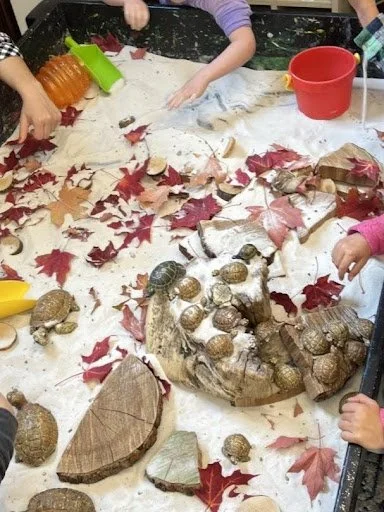
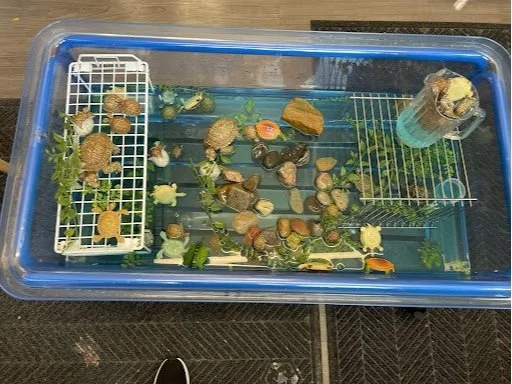
You may have noticed that our toy turtles, which were once in the sand table, have moved to the water. We often change what we offer in the sand and water to inspire different kinds of play. After some time to explore sand with toys for scooping and dumping, we added the turtle figures with tree discs, wooden stumps and leaves to see how kids would use them. Often, animal figures inspire family play in addition to object exploration related to sorting, collecting and filling containers. At the sand table, children assembled family groups on the wooden stumps, buried turtles in the sand and then dug them out, fed them leaf pieces, sorted turtles and filled cups and buckets with them. 

After kids had a chance to explore the turtles and new play themes in sand, we moved the turtles to the water table. Using familiar materials in new ways often inspires children to notice physical differences or to shift their play themes. Children are still playing out themes of family life as they gather little turtles around a mom or dad, help a turtle go for a swim or feed them plants. Some children were invested in hiding the turtles in sand and having them return, much as parents go away and come back when children are at school. Now, they are finding new ways to play out this theme, hiding turtles under seaweed or helping them to swim away and then return to their turtle babies. Children continue to explore concepts of size and volume as they collect turtles in vessels that differ in size and shape from those we have in the sand table. These small changes often inspire subtle shifts in thinking that stimulate growth.

Snack!

Hi everyone!

It’s exciting to see the kids starting to settle in here at school, understand our routines and know that they can rely on teachers when they need help. We also hope that they’re starting to develop the sense that school is a place where they can meet their own needs. They’re starting to understand where materials are, how to get a new paper to paint on, find a marker, store a picture in their cubby. As kids have adjusted to school, we have started to serve snack family style. This means that kids take a portion of the snack from a shared bowl and are starting to pour their own water into their cups. Being able to serve their own snack and put away their own dishes afterward helps develop a sense of agency and competence. All of these procedures, which seem pretty obvious to us adults, present a degree of challenge for  young children. 

Since kids were used to having snack already on their napkins, we showed the new procedure for getting your own snack out of the bowl at group time. Even after seeing this modeled, some kids struggled to understand what to do. Was the serving bowl just for them? What if the bowl is out of arm’s reach? Some like taking the snack so much that they want to keep reaching in and pulling more out even though they have lots of snack on their napkin already. Kids are starting to understand that the serving bowl is really for everyone and that even if you can’t reach the bowl, there are ways to get it (even without climbing on the table or walking around to the other end of it). We’ve let kids know they can say Pass the snack and also added that if they say the name of someone near the bowl, they’re more likely to pass it. As kids start to reference each other at snack, they’re becoming more familiar with each other and starting to have conversations about the food. Kids start to notice that some people share their tastes, but others might have different ideas about what tastes good or familiar. They might even try something they don’t usually eat at home. 

These situations provide opportunities for kids to recognize the needs and thoughts of others, practice using language to express their needs, modulate their movements to avoid spills, and coordinate their actions with others. They’re also developing an understanding that they have the ability to meet their own needs. As spills occur, we show kids where the towels are they can use, so that they can clean up after themselves. At school, everyone spills at some point and accidents are just a part of the learning process. 

And since we’re on the topic of snack, we thought it might be helpful to have a few reminders about snack guidelines. Our snack list is very specific in order to prevent the risk of allergen exposure. Please double check it before purchasing snacks for school. Items that are packaged must arrive with the packaging still sealed (including the box) and the label visible. Any produce that is to be sliced must be prepared at school. As much as we appreciate how much easier it is to prep snack at home, we just can’t allow it due to the risk of cross-contamination. 

We take allergies very seriously here at school. Protecting the health and safety of children is of the utmost importance to us. Because of this, we also ask that you refrain from bringing any additional snacks or beverages to school for your children. It may seem tempting to offer your child a bite of something outside of the classroom, but we ask that you don’t. It is too hard for us to monitor what may or may not contain allergens. Similarly, we ask that you leave your child’s beverage bottle at home. We have filtered water available at school for children to drink. Even if your child’s bottle only contains water, it is impossible for us to monitor what is inside of each bottle or what may have come into contact with the outside of the bottle. It also eliminates the possibility of someone else drinking out of your child’s personal bottle.

Lastly, a housekeeping note. As the weather cools, more of us are wearing coats and other warm items. Sometimes kids put their coats on the wrong hook or have the same coat as someone else. Please label your child’s outerwear to ensure that the correct clothing comes home with your child! 

Thank you :)

Toileting

Hi everyone. It has been so nice to have time to sit down and talk with families during our conferences! One theme that has emerged has been using the toilet. We thought some background information about toilet readiness and child development might be helpful.

At this point in the year, kids in the class are in various stages of toileting. Some wear diapers all of the time, some are transitioning to pull-ups or wear a diaper for naps and overnight. Others might be using the toilet all of the time. Kids are typically ready to start toilet learning somewhere between the ages of 2 ½ and 4. There is a huge range of what normal is, so please don’t worry if it hasn’t happened for your child yet. Each child develops at their own rate, and variation is to be expected. In order to successfully potty train, a child needs to be ready physically, cognitively and emotionally. Understanding the signs of readiness will make the process easier.

A certain level of physical development needs to be in place for toileting. As a toddler develops, the bladder becomes able to store urine and signal the brain to empty it. At this point, you might notice that your child wets their diaper less frequently or wakes up dry after a nap. If a child isn’t able to interpret and recognize the urge to urinate, their bladder will eventually fill to capacity, and they will wet their clothes. Often, the child shows physical signs that they need to urinate before they are consciously aware of the sensation. Some kids are more tuned-in to these physical cues than others. In addition, anxiety or stress may interfere with the ability to recognize them. Similarly, the child must also be able to control their sphincter muscles and recognize the urge to defecate. Though not directly related to toileting, physical development also allows the child to walk to and sit comfortably on the toilet and get their own pants up and down. Toileting will also proceed more smoothly if your child is healthy. This means being free of constipation and diarrhea, which can impede success and slow the process. Some general signs of physical readiness include:

  • Staying dry for 2 or more hours during the daytime

  • Showing signs that they need to urinate (dancing in place, holding genitals, verbalizing)

  • Defecating at predictable times

  • Showing signs that they are about to defecate (going to a corner, squatting, grunting, verbalizing)

  • Disliking the feeling of dirty or wet diapers

  • Able to pull own pants up and down easily

Furthermore, a child needs to be ready cognitively for toilet training. They should understand basic terms related to toileting such as wet, dry, clean, wash, sit, go, as well as whichever terms you choose to use for toileting functions (poop, pee, etc.) and body parts. They should also be able to communicate their own needs verbally and follow simple, one-step directions.

Yet another development piece is emotional readiness. Even though a child may show signs of physical and cognitive readiness, they may not be ready emotionally. Every child begins to explore the world while using their parent as a secure base. It is from this base of nurturing support that the child begins to assert their independence. When a child begins to delight in their abilities and insist on doing things themself, it’s a sign that they may be emotionally ready to begin potty training. This desire for independence and increasing sense of competence is a key motivator. Social awareness is another trait that develops over time and will aid your child’s ability to manage toileting. This awareness of others can inspire interest in the bathroom habits of parents, siblings and peers. As your child develops the desire to imitate the behaviors of those around them, they may begin to show curiosity about their bathroom habits. This interest is a big cue that your child may be ready to begin using the toilet.

Here at school, we have many opportunities to talk with children about toileting. Some are having their diapers changed by us and we may talk about whether they know that they have a dirty diaper, or what made us think that they needed a change. Some children show physical signs that they need to use the toilet and we may comment on that. When children are taken to the bathroom, we usually ask if anyone else would like to go. Sometimes kids trail along just to see what’s happening or to have a chat with teachers. Even the children who haven’t used the toilet at school have been in the bathroom to wash hands. Lots of conversation has been generated by the drawings we have posted in the bathroom of kids using the bathroom. Kids who are hesitant to use the toilet elsewhere may find the small toilet here at school appealing because it’s just the right size.

If you’re thinking about starting, consider if your child is showing the signs of readiness listed above. Also consider the situation at home. If you’re anticipating big life changes like the birth of a sibling or a move, it may be best to postpone potty training. There are a few additional cues that will indicate that you should wait. For example, if your child shows no interest in the toileting habits of parents and siblings, they’re not likely to show much interest in their own. If they avoid or resist talking about the potty, they’re telling you that they’re not emotionally ready. It’s usually best to capitalize on the child’s own interest, rather than trying to force them into it, which may result in power struggles and setbacks.

Once you get started, keep in mind that while some children learn these skills very quickly, it may take others a lot of time and practice. Setbacks and accidents are common and normal. If they occur, reassure your child and encourage them to keep trying. Keep in mind that even the child who has few accidents during the day can’t control nighttime wetting and some children continue to need diapers for bedtime long after they’ve given them up in the daytime.

Last but not least, don’t be afraid to send your child to school in underwear once you get started. We expect children of this age to have accidents, which is why we ask you to send extra clothes to school. We’re happy to help them change. Experiencing that feeling of wetness can actually help some kids make sense of their bodily sensations and functions. Please let us know if there’s anything that we can do at school to support what you’re doing at home.


P.S. Thank you everyone for remembering not to leave your strollers in the courtyard at drop-off this week. Our class will not be using the courtyard yet, so there is no need to bundle children up for outdoor play. When we do use that space with children, we will give you advance warning.

Sharing, Taking Turns, and Protection of Work

We’ve heard of kids who have said, I know about sharing. That’s when my mom takes my toy and gives it to my brother! In our desire to encourage young children to share, sometimes we use adult ideas of fairness and niceties that don’t make sense or feel very good to children. If another child paints on your child’s painting, you might be inclined to say, It’s ok! We can all share. But, think about how you would feel if your work was interrupted by another person who changed what you were doing. You would rightly be offended, and your child has the same right to protect their work from others’ interruptions.


Intentions are good. We want our children to be able to share materials, play together, and consider others’ feelings as they work cooperatively. We share those goals, too, but at Park West we take a different approach. We use a system we like to call Protection of Work. We try to protect children’s work while instituting a system for turn-taking that ultimately helps kids manage this on their own.


So, what to do when your child is the one so badly wanting that turn? First, language can help a lot. We encourage kids to ask for a turn. In the beginning, this means teachers are saying all the words, but this modeling gives kids an idea of what they can say: Can I have a turn?  Are you done? Now the first child can decide if they are finished with the toy or not. If a child grabs a toy from another child, teachers may say: Look! She is using that truck right now. She was holding it. Let's ask her to tell us when she is done. Then go ahead and ask the child who is using it. These exchanges enable everyone to see just how this process works. A way to support kids during these kinds of exchanges is to help the asking child find something to do while the first child finishes their turn. We also make sure to follow through when the first child is finished. Do you remember who wanted a turn? Let’s tell her it’s her turn, now. 


Sometimes teachers do need to help move the turns along, especially if the first child has been using a coveted toy for a very long time. We will remind the first child that their classmate is waiting, or help the classmate ask again, and express that it feels like a long time to wait for a turn. Ultimately we want children to start to consider other children’s points of view and get the idea that this system works, whether they are the one desirous of a turn or the person trying to execute their idea before relinquishing the toy to a classmate. 


Sometimes teachers might adjust the approach, depending on the kids involved, the materials, and the particular situation. Everybody might want a turn with a new toy in the classroom, so teachers might help orchestrate shorter turns until the frenzy dies down. At some point, we might use a sign up sheet to help track all the kids who are waiting. At other times, a child may need a little more time to finish their turn, even if it means the child waiting has to wait until the next school day. What’s important to us is that these different approaches all can further the trust that everyone who wants a turn will get a chance and that there are people — parents, teachers, friends — who agree to this same process and will help facilitate it.


Materials like magna tiles usually have enough pieces for several children to play at the same time, but if one child is using all of the pieces we might point out, “You’re using all of them, and there are none for Alex to use. Which ones could she use?” Sometimes, Alex’s desires are specific so we might ask her, Which ones did you want? Then we’d help Alex ask for those. She may just need two more squares to finish the sides of her house. If the first child really resists, we might have to say something like, Can you give some to Alex, or should I help you? Children who experience this Protection of Work tend to relax when they realize that there is a system in place that works, whether they are the person wanting a turn or the person having the turn. After learning how to ask for turns, take a turn and let somebody know when you’re finished or not, children are freed up to use the materials. Once they know that they can ask for a turn, children begin to use the technique with kids in their families or in other venues. Parents can help siblings implement the strategy, even with toddlers who don’t really understand or have the words yet. Baby is using that right now. Let’s tell him you want a turn, and then wait until he’s done or I see Baby trying to grab that. It looks like he wants a turn. Can you tell him you’re using it? I’ll help him find something else to do, but let’s be sure to give him a turn when you’re finished.


When children get to the point when they are motivated to share materials with another child, it’s because the drive to be together helps them override their desire to have all the turns or keep all the materials to themselves. 


When we help kids ask each other for turns, honor their right to work with materials until they’re finished, and follow through consistently, children feel empowered to manage turn-taking and sharing in a way that is effective, that makes sense, and that feels good to them.

Assisting

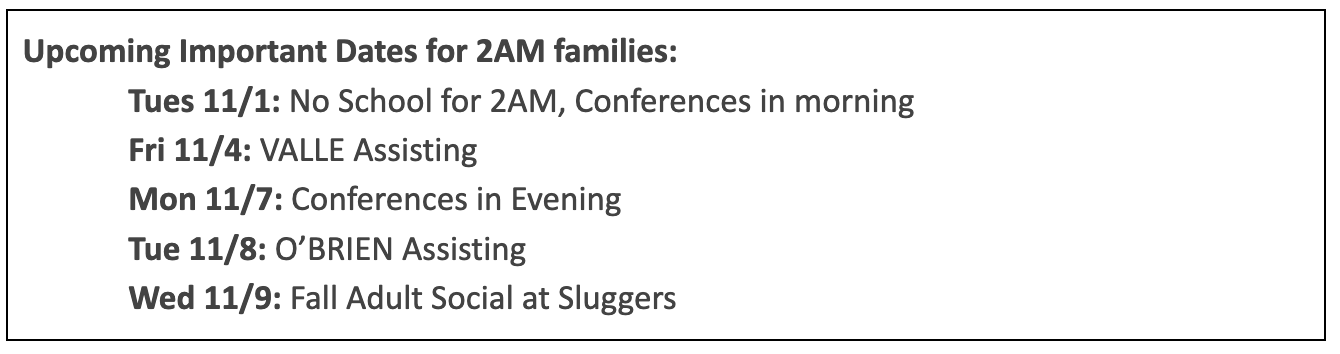
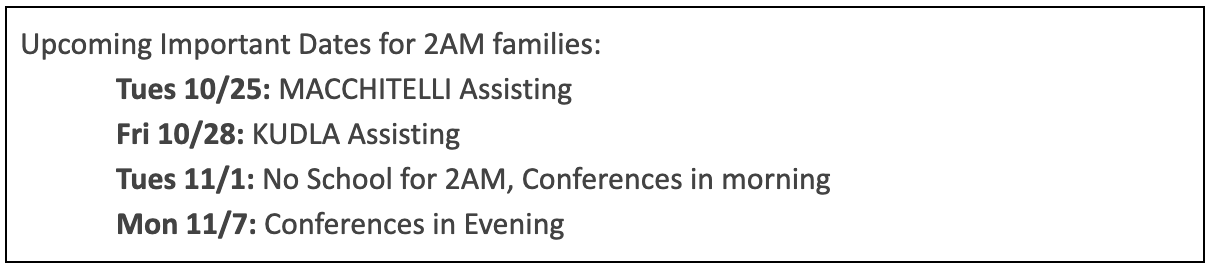
Have you had your turn to wear the red apron yet? We are very excited to have you join us in the classroom on your assisting day. In the very beginning of the school year, assisting feels very different, as there are many parents in the classroom. As the number of parents remaining with us begins to thin, this experience begins to shift, too.

Assisting can only be done by a parent. This is a time to share your child’s school experience, witness how the class operates and come to know your child’s peers. For children, these days can bring heightened emotions as they face excitement about having a parent with them in addition to some uncertainty about the changes that come with assisting. This means that in addition to smiles, there may be some tears. Children approach these days in unique ways. Some may wish to spend every minute with you or even cling to you, while others may prefer to play independently or not seem to notice that you are present. This is all fine! Try to follow your child’s lead and be prepared to support them in whatever way they need. Teachers are here to help, so don’t hesitate to get us if you’re feeling stuck.

If you are able, please do share play with other children, put names on paintings, help children get smocks on and paintings to the drying rack. If you encounter any situations that you are unsure how to handle, let teachers know, we’ll be happy to step in! Teachers will help children in the bathroom, so please let us know if you notice a child other than your own who needs to use it.

On your assisting day, we ask that you come about 20 minutes early and bring the snack. Because of allergies, our snack list is very specific, and teachers will check to make sure the items you bring are on it. For the same reason, we are very specific about where snack is stored and prepped. In order to prevent allergen exposure, we only use the section of the kitchen that is designated for our classroom. Please also take dish bins directly to the sink rather than setting them on countertops in other areas of the kitchen.   

After you arrive, teachers will help you get started on snack prep and will show you how to set tables for snack. When office staff open the doors for arrival, we will typically ask you to greet children and help them enter the classroom. When the class goes downstairs for gym, you will remain in the classroom to clean tables and set up the snack. Your child may prefer to stay with you or accompany us to the gym, either way is fine.

Your child may wish to wear the red helping apron, or they may not. Whatever is comfortable for them is fine with us, but we ask that you wear one so that children can identify you as the helper.

We ask that you not use your cellphone or take photos during class time. If you must take a call, please let us know that you need to step out of the room. We are happy to take photos of you and your child in your red aprons either before or after class, when other children are not present.  

On this day, you are part of our team in the classroom. At school, you might witness challenging behaviors from children. This is to be expected as children become accustomed to group life. We ask that you respect each family’s privacy and not share difficult moments that you witness in the classroom.

At the end of the day, we ask the assisting parent to stay and complete a few classroom chores after dismissal. We will guide you through them and have them listed in the classroom. If you need support in completing these tasks, we are happy to help.

No matter how your assist day goes, it will offer insight into your child’s approach to school, how the classroom operates and the other children. We deeply value your presence in the classroom and look forward to partnering with you in this way!

Separation: At school, at home, and beyond

It has been exciting to see children coming to know school and settling into classroom routines. We’re noticing children go right to the sink for hand-washing as they enter and anticipate the parts of the school day. Lots of children ask things like “we go to the gym?” or “snack now?” In addition, many are coming to know where things live. They know where the dollhouse is, where smocks are hung, and which shelf holds the puzzles. Your support during these first days of school, as children adjust to this new space and the challenges of group life, has been instrumental in creating this level of understanding and comfort. Research shows that children enter new spaces more easily with a trusted adult, which is one of the reasons we ask you to accompany them during these first weeks of school.

As children become more comfortable at school and with teachers, we’re starting to send parents out of the classroom, little by little. Though we’re excited to get going with our regular school routine, we also understand how important it is to honor this separation period.

Separation is an ongoing developmental issue. Each time a child separates from their parents or familiar setting, they draw on their own developing inner resources. But how do those resources develop? Initially, young children rely on their caregivers to help them regulate their emotions and meet their needs. As they enter the nursery school setting, they must begin to transfer the trust they have for their parents to teachers. It can take time to develop a trusting relationship with teachers. Having a familiar adult along can give children the security to begin to make a connection with teachers. Children also need reassurance that adults will return. Practicing some comings and goings helps children understand that adults will come back and that they can be trusted to do what they say they will. As difficult as goodbyes can be, our goal is not to protect children from their sadness. Instead, we seek to support each child in acknowledging and expressing their emotions around saying goodbye. This is a serious emotional challenge. These early experiences with separation set the stage for every subsequent goodbye, whether it be spending the night at grandma’s house or leaving for college. As children develop and practice coping skills by separating from their trusted adults, they build self-confidence and a sense of security.

Here are a few ideas for you to try at home in order to support the separation process at school:

  • Try acting out saying goodbye to a parent at school with toys. You might start by saying that a toy is going to school and will be saying goodbye to their mom. Voice what each character is saying and feeling as you play out this scene. Invite your child to contribute as you play. Perhaps your child could help the toy figure out what to play after Mom leaves or when Dad will return. Some children enjoy playing the parent role in these scenarios. Others may just watch and not participate at all.

  • You might also have a conversation with your child’s teddy bear or other toy, in which you voice the toy’s feelings around saying goodbye, affirm the feelings, ask them what helped them feel better. Help the toy know they could ask a teacher for help.

  • Act out parts of the school day.

  • Review the school schedule at home.

  • Develop a ritual around saying goodbye (for example, draw a picture together first, ask your child if they want one or two hugs first, give them something of yours to hold)

If you have not yet sent us a family photo, headshot of your child or an extra change of clothes, please do so ASAP. 

It has been a real pleasure getting to know you and your children and we are thrilled to share these beginnings with you!